
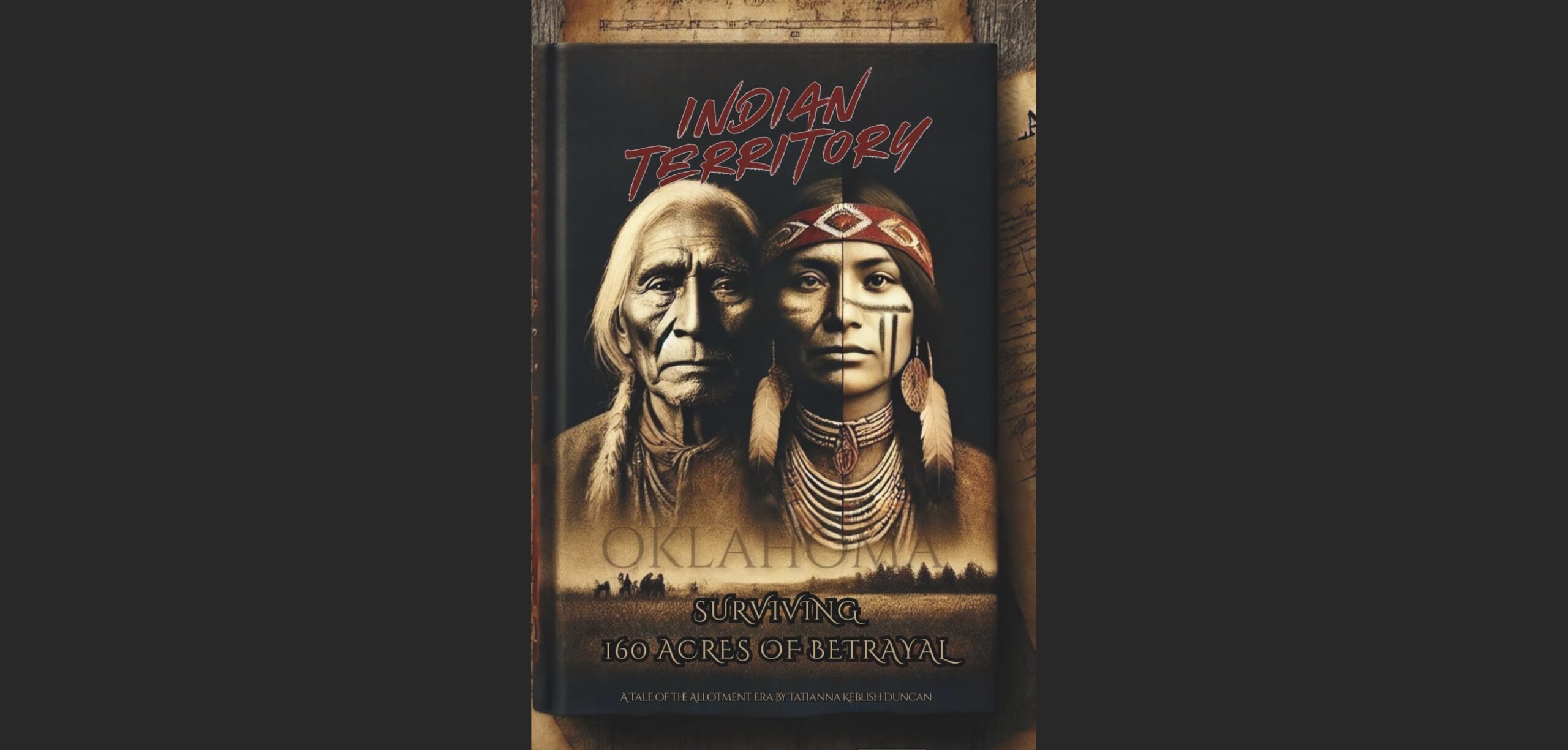
Editor’s note: The following is an excerpt from “INDIAN TERRITORY: Surviving 160 Acres of Betrayal,” written by Tatiana Duncan. For Duncan, “I chose Chapter 17 because it summarizes much of what the Hickory’s experienced — and many other Creek families — endured during the Allotment Era.” Duncan’s book is available for purchase on Amazon.com
Chapter 17
They Were Not Silent — They Were Silenced
As the battle rages on…
The court cases and ongoing legal battles over the land have been complex and deeply unsettling to unravel. They were bullied, coerced, and forced into poverty through illegal and exploitative means. In my heart of hearts, I will always believe that many of my ancestors were murdered, though I know I’ll never be able to prove it. That’s why I call these events “red flags.” At best, the speculators preyed on the family’s grief, the youth of the children, and the language barrier faced by the father. At worst, they enacted a systematic and ruthless campaign of theft, manipulation, and murder.
The stress of this relentless battle must have taken a heavy toll on the children’s education and well-being, forcing them to constantly worry about their father’s treatment and the fate of their home.
Relocating was not as straightforward as it might seem. Like many other Native American families during the Allotment Era, the Hickorys discovered that their guardian had mismanaged their business affairs and spent their money, leaving them in debt. Although they unwillingly sold their property, they knew they had to decide to move on, but not without getting a fair price.
Campbell’s initial attempts to acquire the Hickory family’s land were driven by plans to develop what began as an average middle-class neighborhood. However, as the fight for the land stretched over the years, its value skyrocketed, transforming it into prime, wealthy real estate.
Despite this, Campbell sought to shortchange the Hickory family, paying them only a fraction of its true worth—a drop in the bucket compared to what had already been taken from them.
The Hickory children, like so many Native allottees, helped build Tulsa—not just by hand, but by checkbook, and not by choice, but through fraud.
Their inherited wealth paved roads, funded development, and lined the pockets of powerful men. Meanwhile, the children were thrown into poverty. The education they received from their inheritance wasn’t one of privilege or higher learning. It was a masterclass in betrayal and survival. They learned, firsthand, how dark and deceptive the colonized world could be. And yet, they forged ahead with incredible tenacity.
My grandmother and her siblings weren’t allowed to nurture their talents—neither in the colonized world nor in their Creek culture. Their past was destroyed, their present was hell, and their future was stolen.
How could they prepare the next generation for a world they did not know and could not trust?
I think of something as simple as piano lessons. That kind of privilege wasn’t even a consideration—not for them, not for me. We didn’t ask, “Can we afford lessons?” We asked, “How will we pay the bills?” “How do I best help my family?”
And maybe that would’ve been just fine if they had been immigrants who arrived with nothing. But they were not immigrants, they had land, they had money. And they were surrounded by opportunists, always ready to take. Their futures were hijacked—their birthright was stolen—
And the thieves got away with it.
As a society, we shrug it off. “Well, nothing can be done about that now.”
Why not? If you’ve never experienced this kind of injustice, you might not understand how deeply it still lives inside us.
So, before you say, “That didn’t happen to me,” let me be clear: oh yes it did. It’s still happening. And before
you tell me about your uncle or your cousin and how they lost land too—remember this:
WE ARE INDIGENOUS.
This land was entrusted to our care. We thrived when we were allowed to care for it. Today, we survive. But so many of us have been denied the chance to truly thrive.
The Allotment Era absolutely shaped my life. And once I began researching it through my own lens, not through the lens of outsiders. When I did this, I could finally see that the story we’d always been told, was true.
One of the hardest truths to face was reading how my great-grandfather, Thomas Hickory, and his children were kept from the very home he built with his own hands.
They weren’t just locked out—they were run off. Forced to leave the home they built, on the land they owned, treated like intruders in their own story.
How would you feel? I already know.
My family lived it.
My family carries it still.





this happened to our family but was by their own family members
Your story should be made into a movie.
I read an excerpt of your book it fills my heart with sadness. I wished It could have been different for you and your family and many other American Indians long ago. I encourage you to continue to tell your story to the generations ahead who are looking to find a purpose in their lives. My prayer is for you and your family to find the strength to carry on in this life. God bless you. (this book can be a movie, that come to my mind as I was reading) My nephew is a documentarian a specialized filmmaker.
WOW JUST WOW 😮 THANK YOU FOR SHARING