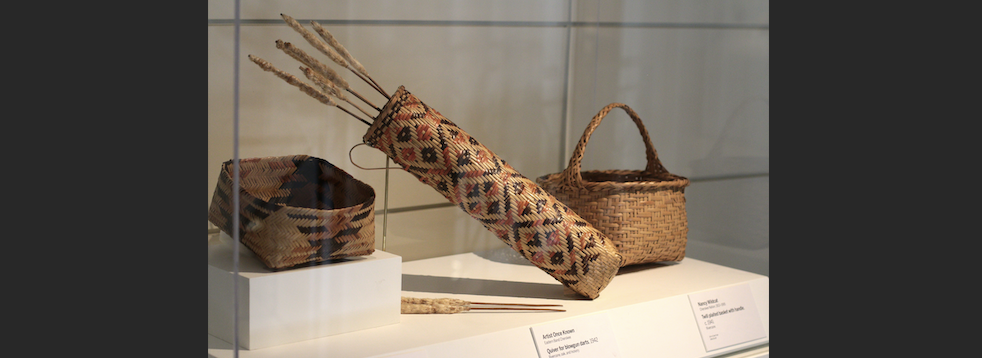
TULSA – “Interwoven:Cherokee, Muscogee (Creek) and Yuchi Baskets” at Tulsa’s Philbrook Museum of Art is currently on display through Feb. 8. The exhibition highlights the shared history and artistry of basketmakers from the ancestral Homelands of the southeast. Welana Queton (Osage/Mvskoke/Cherokee), the Mellon Fellow for Native Art, curated the exhibition and spoke to Mvskoke Media about the inspiration and process behind her exhibition.
“Interwoven is a historical and contemporary basket from the Cherokee, Mvskoke and Yuchi people who share the ancestral homeland of Carolina’s, Georgia, Tennessee and Alabama. They also share the classical art of basketmaking,” Queton said.
“I titled this “Interwoven” with several meanings there, saying that Tulsa is an interwoven community in the Cherokee, Mvskoke and Yuchi peoples, we all share this community of Tulsa.”
The baskets are from the museum’s permanent collection and Queton was given three months to create the exhibit, which required following rules regulated to the Native American Graves and Repatriation Act (NAGPRA). To comply with NAGPRA confirmation needs to be attained from the source Tribes.
“People have to give approval to show their material cultural items in museums and so that was part of the work, and also consulting with all of the tribes,” said Queton. “Philbrook has a really large collection of baskets. It’s probably one of the top 5 in the United States, a lot of them come from California and other tribes,”
Queton was grateful to be able to work with Tribes, including the Muscogee (Creek) Nation. She got quick approval from all the Tribes, and the MCN was also able to do an on-site consultation, the rest were over email.
During the process, she was able to consult with two Yuchi consultants for the exhibition. For Queton, the inclusion of Yuchi basketry was stirring- she’s been working in museums and collections for over 25 years and doesn’t see many Yuchi materials in collections.

“I was very excited about these, seeing these here and seeing these baskets. They were made by a husband and wife, George (Yuchi) b.c. 1853 and Fannie (Yuchi) b.c. 1865 Fulsom. The years are circa 1875 and they’re actually the oldest baskets in the whole exhibition. One is repaired heavily with a cotton strip, just showing the heavy use of it,” Queton shared.
Queton is filled with excitement to bring these baskets out for the Yuchi people because she knows that they don’t get to see a whole lot of items anywhere. Also she is happy to be able to bring these baskets out for the Mvskoke people and have their items placed there at the museum too.
Queton explained that baskets aren’t able to be brought out often because they’re made of organic material, which means they don’t last in a lot of collections very long or they’re often part of unexhibited archaeological collections.
“So to have these in that period, represented here at the museum, was special as well. I just wanted to bring that out for all of our people here because this is our homelands now and this is our home. I think we should be represented in the exhibitions around here, so I was able to do that,” Queton said.
It’s important that the collection highlights history and the cultural value of the objects and why they were made, not just the materials that were used to make them.
“I was able to say something like green corn ceremony in relation to these baskets. I’m talking about corn, what it was and it still is. There’s a sacred element to Mvskoke and Yuchi people, it’s traditional processing,” said Queton.
“Its processing is fundamental to the annual green corn ceremony. The little things like that, I’m able to bring out, able to talk about some history, some values that we may see in these things that non-native people might not see.”
Queton is also proud of the public outreach her job allows her to do. “If we can help in some little way, provide another narrative or another way of understanding to a non-native person that makes me feel good. Like I’ve accomplished something, like I’m helping them see a different way and there are different ways of belief, there are other different ways of putting more visibility within these colonial spaces,” Queton said.
Queton encourages everyone to Philbrook to come see the baskets- visitors can request a tour with Queton herself, Monday-Friday.
“Interwoven: Cherokee, Muscogee (Creek), & Yuchi Baskets” runs through Feb 8 at Philbrook Museum of Art, located at 2727 S Rockford Road in Tulsa. Philbrook is open Wednesday and Thursday from 9am-5pm, Friday through Sunday from 9am-4pm. Special holiday hours Monday, Tuesday, and Friday-Sunday from 5:30-9:30pm. The museum is closed Mondays & Tuesdays during the day.