
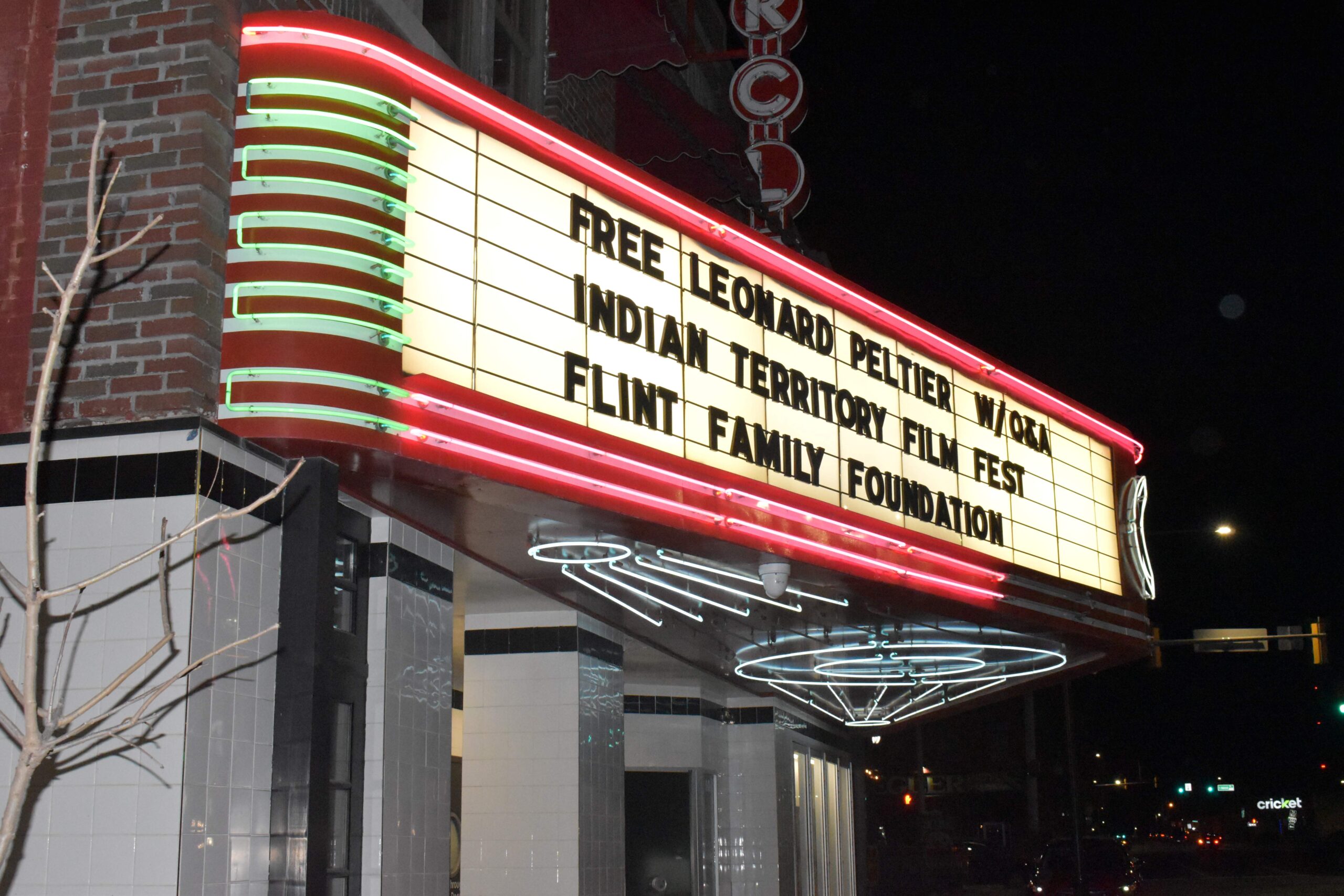
TULSA – The life and struggle of Native activist Leonard Peltier (Turtle Mountain Chippewa/Ojibwe/Lakota) was brought to Circle Cinema in Tulsa in a screening of the documentary “Free Leonard Peltier” on Dec. 18. The screening was a one-night-only event that was free and open to the general public and was sponsored by Friends of the Circle, the Indian Territory Film Festival, and the Flint Family Foundation.
The documentary, directed by Jesse Short Bull (Oglala Sioux) and David France, tells Peltier’s story: how he became involved with the American Indian Movement, how he rose in leadership, and how he and several others ended up at the Pine Ridge reservation in North Dakota. It told of how he was accused of the murder of two FBI agents and sentenced to life in prison, based on testimony that was later called into question.
While the documentary has no new interviews with Peltier, now 81, it mixes old interviews with him and current interviews of his friends, colleagues at AIM, and Tribal elders. Descriptions of threats and coercion by the FBI into giving false testimony against Peltier are detailed in the film, the most notable being Myrtle Poor Bear, whose interview was shown in the documentary. Poor Bear initially testified against Peltier, despite never meeting him, and claimed she was his girlfriend, only to later recant her statements.
The documentary also tells the history of AIM’s altercations with the U.S. government, including the occupation of Alcatraz, the Wounded Knee occupation, the takeover of the BIA building, and the Pine Ridge shootout. The documentary shows the conflict between AIM and the federal government being exacerbated by individuals like Dick Wilson. Wilson, the then-Tribal President of the Oglala Lakota tribe, with the support of the federal government, harassed, threatened, and endangered AIM members using his own personal militia, the Guardians of the Oglala Nation, also known as the GOON Squad.
The film ends with Peltier’s commutation from President Joe Biden, which placed him under indefinite house arrest in his home in the Turtle Mountain Reservation in Belcourt, North Dakota- the release occurred one week before the film’s premiere.
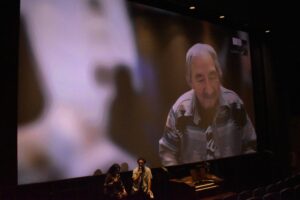
The screening of the film was capped off with a Q&A, which featured producer Jhane Myers (Comanche, Blackfeet), moderator Sunrise Tippeconnie (Navajo, Comanche) of the Reel Indigenous Podcast, and Peltier, who joined via Zoom from his home.
When speaking to the crowd over Zoom, Peltier took a moment to thank people for standing up for not just him, but for Indigenous people as a whole.
“I’m glad to see our future generations standing up the way they are. All of you young people that are out there standing up for our people. You made me feel good in my heart that any sacrifice I may have made was not at all in vain. You gave me hope that we would be victorious, and we will be. I’m not gonna give up. I’m not gonna give up til the day I die,” Peltier said over Zoom.

Myers also spoke of how excited she was to help Peltier tell his story.
“At first, I was just like ‘Oh my God, there’s Leonard Peltier.’ It was huge for me, because here’s this icon. I think I was 12 or 13 when the American Indian Movement was happening, and, you know, here he is, like right here,” Myers said.
“At the end of this call we had, I was watching our monitor, I was almost starting to cry, just because never in my life would I think that I’d have a chance to help or use my talent, use my career, or use my name as a part of this to try and make a difference.”
Myers also spoke about the expansion of the film’s scope from being just about Peltier and why they felt the need to speak on Indigenous activist movements like AIM as a whole.
“What you saw in the film is that we wanted to change it to show not just Leonard’s story, but the native activism as a whole. Because over time, activism has changed, and I wanted people to be able to see the Natives that were on the ground and that were doing this work,” Myers said.
“Like he says, it’s not just us. We stand on the shoulders of all of these activists that came before us, all of the people that had prayers about this and wished for this to happen.”





UUHHH, DEFINITELY A WRONGLY CONVICTED NATIVE, SHOULD’VE BEEN GIVING A HIGHLY SUBSTANTIAL AMOUNT OF MONEY. !!$$$$
We people of Eufaula would have been there but didn’t get a notification of this. showing. You need alert our communities about these documentary s. Its Indian education to its fullest because it’s real and it happened.