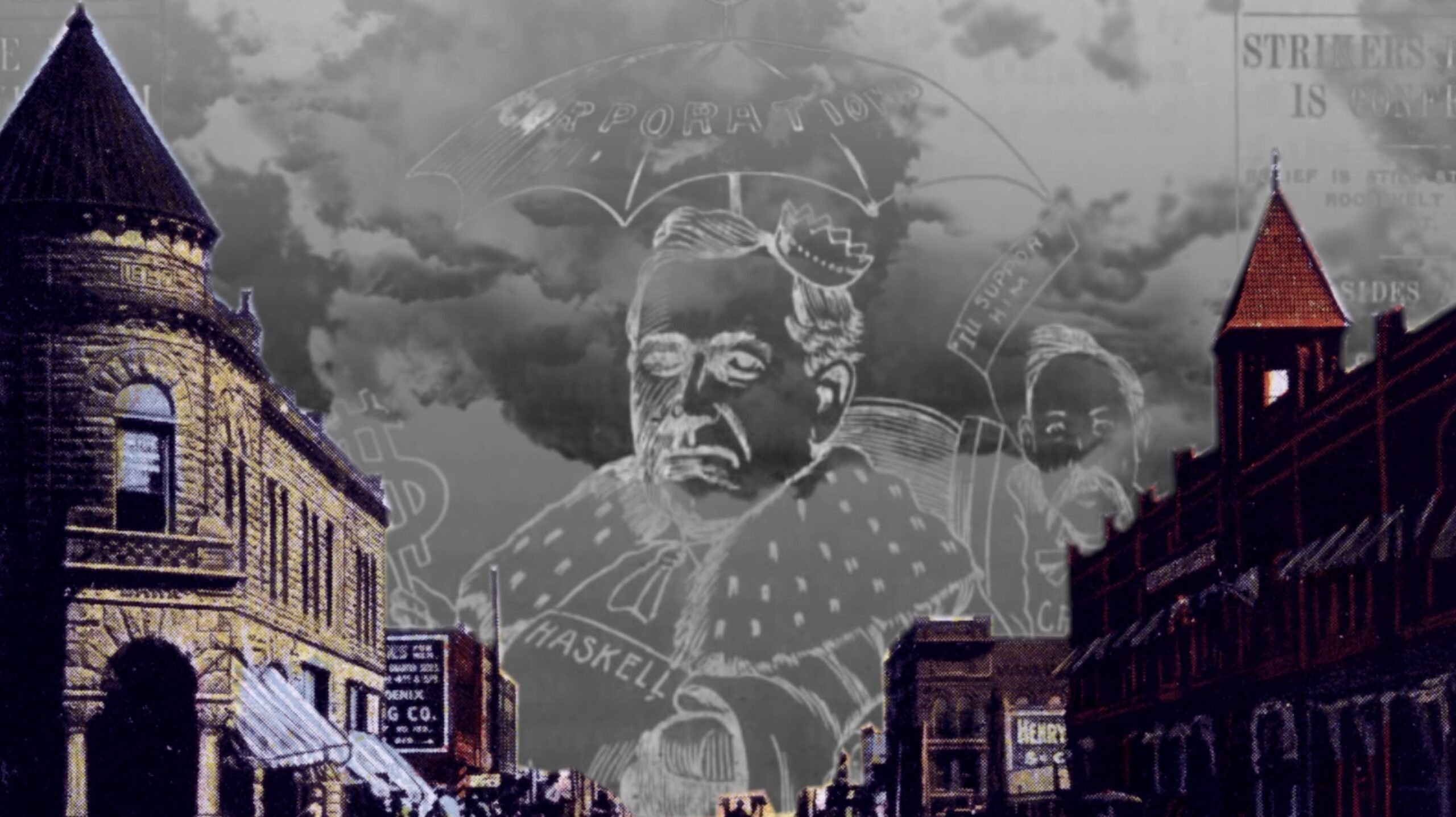
Allotment of Tribal Land in Indian Territory was an essential step in the United States Government’s plan for Native American assimilation. As Oklahoma statehood loomed, wealthy businessmen and politicians conspired to profit from the confusion and chaos created by the allotment process. Mvskoke Media presents: What are the Muskogee Town Lot Frauds?
The information in this article is based on contemporary news reports and on research conducted by author Russell Cobb, as presented in his Substack article “What was Haskellism?”
In 1900, the Muscogee Creek Nation negotiated an agreement with the Commission to the Five Civilized Tribes that was ratified by an act of the United States Congress in 1901. This agreement set down the myriad ground rules for the allotment of land on the Mvskoke Reservation in what was, at the time, Indian Territory. Part of this process required the MCN to examine the titles of town lots in various cities on the reservation.
MCN Principal Chief at this time was Pleasant Porter, who was elected in 1899 and re-elected in 1903. The same year, Charles J. Bonaparte, a member of the Board of Indian Commissioners, recruited William Dudley Foulke to investigate the various Indian land frauds happening in Indian Territory. Foulke had been a commissioner in the U.S. Civil Service Commission under President Theodore Roosevelt and had recently retired from that position.
On October 14, 1904, Chief Porter publicly called for the prosecution of anyone who enrolled for allotments in the Mvskoke Nation by fraud, claiming that 700 individuals had done so. According to Porter, “We have proof against several persons who have been illegally enrolled, and we will be able to secure proof against about 200 more within the next few weeks.”
Later that same October, the MCN House of Kings passed a bill demanding that the U.S. Secretary of the Interior appoint a committee to investigate the alleged fraudulent sale of town lots in 25 townsites in the Nation.
One year later, at an MCN National Council session, Porter’s annual message concerning the progress of the Nation was read. Among the topics discussed was the need for the MCN National Council to appropriate funds to investigate fraudulent enrollments. Porter expressed doubt that the federal government would pursue a criminal investigation into the matter and recommended that civil cases be filed on behalf of the Nation to recover the lost allotments.
Foulke delivered his report on the situation to President Roosevelt in 1906. Contemporary news coverage of the report published in the New York paper The Sun on December 22, 1906, described how the frauds were executed:
Under the law governing the disposal of the Creek lands, town sites covering an area of four acres may be procured by individuals if they desire to erect a home and business houses on such tracts. The law prohibits an individual from acquiring more than one site or lot. Through a method of fraudulent scheduling, a number of persons, among them whites and “civilized” Indians, secured town lots aggregating in value something like $5,000,000 or $6,000,000. A better idea of the values in the Territory is given in the assertion, made upon the authority of a Department officer, that certain tracts in Muskogee are worth $300 a front foot. The grafters, it is asserted, were enabled to get land to which they were not entitled under the law by employing dummy purchasers, who transferred the title after the deal was closed. It is asserted that certain officials in the Territory, or at least corporations with which they are connected, are in possession of Creek lands that were secured through fraud.
Following Foulkes’ report in 1907, a number of separate civil suits were brought by the United States and by M. L. Mott, attorney for MCN, against several individuals accused of participating in the town lot frauds in Muskogee. Listed among the defendants were F. B. Severs, C.W. Turner, A.Z. English, as well as Muskogee Title and Trust Company.
Mott also filed suit against Chief Porter, C.W. Turner, and the Board of Home Missions of the Presbyterian Church. The suit alleged that Porter and Turner executed a quit-claim deed of 27 acres in the city of Muskogee to the Board. This land was the site of Henry Kendall College. An act of Congress from 1898 had provided the various colleges in Muskogee with ten acres of land, on the condition that the land was already occupied by the colleges. The suit alleged that the title to the land was obtained by fraud and that the college was in possession of 27 acres, 17 acres more than the prescribed 10. The Board planned to move the college to Tulsa and obtain $100,000 from the sale. Henry Kendall College would later become the University of Tulsa after relocating.
On September 3, 1907, Pleasant Porter died after sustaining a stroke during a layover to change trains in Vanita, I.T. This dismissed the MCN suit against Porter.
Moty Tiger was soon after appointed by President Roosevelt to succeed Porter as Principal Chief.
On November 16, 1907, Oklahoma was admitted to the Union, becoming the 46th state. Charles N. Haskell was immediately sworn in as the state’s first governor.
A federal grand jury would hand down seven criminal indictments in the Muskogee town lot fraud case, a little over a year later, on February 3, 1909, with Governor Haskell being the most prominent among them. Haskel’s indictment charged him with conspiracy to defraud the government. Clarence W. Turner, W. T. Hutchings, Frederick B. Severs, Albert Z. English, and Walter R. Eaton were also indicted as part of the plot.
The trial began on April 5. The attorneys for the prosecution were District Attorney W. J. Gregg and Assistant United States Attorneys Sylvester Rush and Oliver E. Pagen. John Marshall was the presiding judge.
Marshall eventually ruled that the indictments be quashed, finding that the grand jury which returned them had been illegally formed. Marshall’s ruling pointed out that at the time the alleged frauds occurred, Muskogee was in Indian Territory, and as such was subject to the Curtis Act. The Curtis Act specified that courts in the Territory had to operate in the same manner as courts in the state of Arkansas. This meant that the grand jury needed 16 men, with only 5 needed to prevent or return an indictment. Instead, the prosecutors had used the general federal grand jury law, which provided for a jury of 23 men and required 12 to return an indictment.
On April 29, United States Attorney General George Wickersham ordered Gregg to empanel another grand jury in the case, which was scheduled to meet in Tulsa on May 10 of the same year. Haskell and the others were again indicted, and a new trial began in May 1910, with Judge Marshall at the helm once more.
During the trial, Judge Marshall ruled that the prosecution would have to prove Haskell’s conscious participation with the other defendants during the three years preceding their May 1909 indictment. This was due to recent changes to the statute of limitations as a result of the United States Court of Appeals, Eighth Circuit ruling in Lonabaugh v. United States
Because the alleged conspiracy took place in 1902, much of the prosecution’s planned evidence was inadmissible. U.S. Attorney Rush stated in court:
Your Honor, it will be impossible under the evidence which we have collected to prove a conscious participation on the part of all these defendants, Haskell, Eaton, and Hutchings, in the money payments made by the defendant Turner, which were the only overt acts in effecting the object of the conspiracy within the statutory period. We do not feel justified in taking up the time of the court further with these cases, and we suggest that nolles be entered as to all.
The prosecution had made a motion to enter nolle prosequi in the case. Nolle prosequi is a Latin term that means to be unwilling to pursue. In legal terms, it signifies that the prosecutor is no longer willing to pursue the case against the defendant. This ended the most high-profile criminal land fraud case in the history of early Oklahoma.
Mott, the MCN’s attorney, had been busy throughout this period, filing civil cases. The Nation obtained $40,000 and 110 lots through a settlement with Albert Z. English and Frederick B. Severs, two individuals indicted along with Haskell. In 1913, 27 lots were recovered from Frisco Oil and Gas Co. in Tulsa. According to contemporary accounts, by 1939 the Nation had recovered about $100,000 through cash settlements and lot resales. An estimated 55 lots recovered by the Nation remained unsold.
Mott was replaced as MCN attorney in 1914 by Judge R. C. Allen.
Allotment land frauds and recoveries would have an indelible impact on the Nation’s future. Court rulings, land titles, and historical obfuscations dictated the locations and opportunities, economic and legal, that MCN would have over the course of the 20th century and into the present era. Mvskoke citizens and descendants continue to seek out allotment information and learn about their heritage.
The Muskogee town lot frauds were only a fraction of the allotment frauds that took place on Tribal reservations in Oklahoma. These historical frauds continue to affect Tribal governments and citizens to this day.