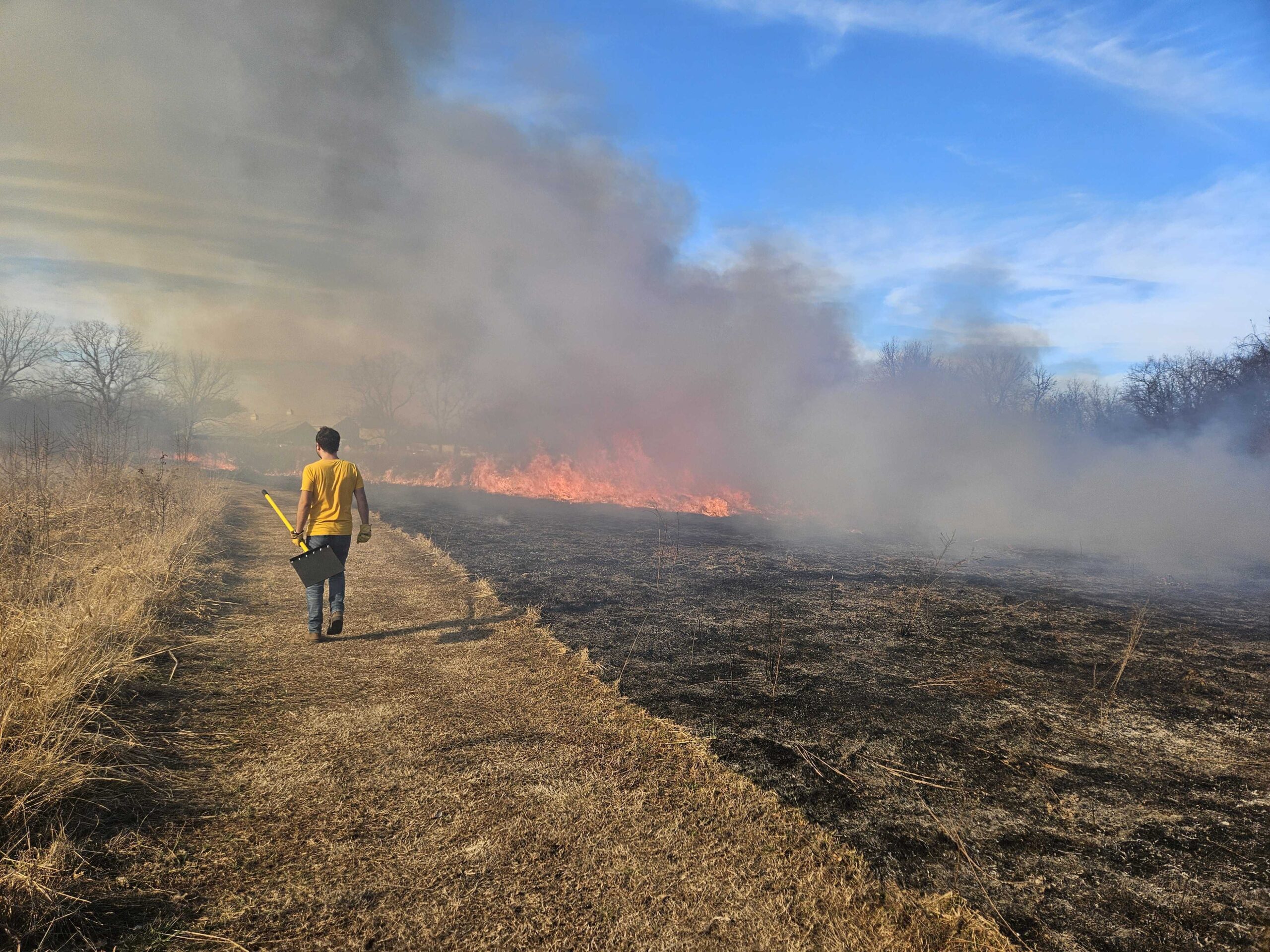
MVSKOKE RESERVATION – For generations, fire was a regular part of Oklahoma’s landscape. Today, decades of fire exclusion have allowed woody plants to expand into grasslands and open woodlands, while changing environmental conditions are adding pressure to those landscapes.
Those changes can include increasingly variable periods of wet and dry weather, which can produce vegetation during wetter periods that later becomes fuel during drought. Rising atmospheric carbon dioxide can also favor the growth of woody plants over the warm-season grasses common across Oklahoma, according to Oklahoma State University Rangeland Extension Specialist Laura Goodman. Together with decades of fire exclusion, those conditions can contribute to woody encroachment and increase the amount of fuel available during wildfires.
Prescribed fire can help address some of those problems. But knowing fire could benefit a property and having the people, equipment, and experience to safely put it on the ground are two different things.
Across Oklahoma, prescribed burn associations, or PBAs, are working to close that gap through a model that Oklahoma State University Senior Extension Specialist John Weir simply describes as “neighbors helping neighbors.”
Weir helped establish one of Oklahoma’s first burn associations around 1997 while working at an OSU research range. Nearby landowners saw prescribed burns taking place at the research property and wanted to use fire on their own land.
The solution was to pool their resources.
“It’s the old way of, you know, just like a barn raising or branding where people get together and help each other out,” Weir said. “It’s very difficult to do by yourself, and having more equipment, more people there to help makes things simpler and easier and also safer.”
The model tackles a practical problem surrounding prescribed fire: a burn can require drip torches, water tanks, sprayers, weather equipment, and other tools, along with enough people to ignite the fire and patrol its perimeter.
But the reason for returning fire to the landscape begins with the land itself.
Goodman said much of Oklahoma has historically experienced fire regularly. When fire disappears for extended periods, one of the most visible changes is the spread of Eastern Red Cedar.
The tree is native to Oklahoma, but without fire, it can expand into areas where it was historically less prevalent. Dense cedar can shade out grasses and other vegetation, reducing available forage for livestock and altering wildlife habitat.
Goodman said prescribed fire can also influence when vegetation grows. Depending on the season and a landowner’s goals, burns can encourage new growth and alter when grasses begin or end their growing season.
Those decisions are important because prescribed fire is not one uniform treatment.
“You’re looking for a specific prescription,” Goodman said.
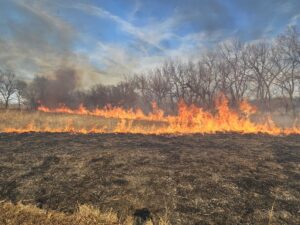
That prescription can include wind direction, humidity, firebreak conditions, and other factors. The appropriate season and frequency also depend on what the landowner is trying to accomplish.
For wildlife, that can mean creating distinct habitat stages within the same property.
OSU Wildlife Extension Specialist Mark Turner said recently burned areas can provide nutritious vegetation and brooding habitat for species such as wild turkey and northern bobwhite quail, while areas that have gone longer without fire can provide nesting cover.
Rather than burning an entire property at once, landowners can burn different sections at different times, creating a mosaic of habitat conditions.
Turner said managers can evaluate whether those treatments are working by looking beyond wildlife sightings and examining the vegetation itself: whether woody plants decreased, flowering plants increased, or the overall plant community became more diverse.
Prescribed fire may also improve a landscape’s resilience to wildfire, but Turner cautioned against interpreting that to mean prescribed burning prevents wildfires.
Fuel begins to accumulate again after a burn. A previously burned property can still burn during a wildfire.
The difference, Turner said, is that frequently managed areas may have less accumulated fuel and woody vegetation, potentially reducing the severity of a later fire.
Prescribed fire is not a solution to climate change itself. Instead, it is one management tool that can address specific pressures affecting Oklahoma landscapes, from woody encroachment to accumulated fuels.
For many landowners, however, the challenge is putting that tool into practice.
Goodman said burns typically require several people. While one person ignites vegetation, others may patrol the perimeter, watch firebreaks, or operate equipment. Larger burns require even more help.
PBAs create a network in which landowners can provide those resources to one another. They also provide something harder to purchase: experience.
“We learn a whole lot better by doing,” Weir said.
New members can participate in burns alongside experienced practitioners, learning how fire behaves under different conditions before taking on greater responsibility themselves.
Turner described that knowledge as particularly important because prescribed fire is both “a science and an art.”
Research can provide guidance about weather, time, and fire behavior, but no two properties or burn days are exactly alike. Conditions can change, equipment differs, and practitioners have to know when a burn is behaving as expected and when it is time to stop.
That community model is now taking shape on the Muscogee (Creek) Nation Reservation in Okmulgee County.
OSU Agriculture, 4-H, and Federally Recognized Extension Tribal Program educator Shelby Lofton said local interest in prescribed fire initially led her to organize a workshop that drew more than 120 participants.
Afterward, a member of the Okmulgee County Cattlemen’s Association approached her about establishing a local burn association. Lofton connected him with Weir and other resources, eventually helping develop the association and additional hands-on training.
The new association is still in the training stage and has not yet conducted its own burn, meaning its ecological impact cannot yet be measured.
Lofton said the interest itself has demonstrated one of the challenges PBAs are designed to address.
“Mostly one is equipment, and then having people,” Lofton said. “A producer could have 500 acres. You can’t monitor 500 acres by yourself.”
That does not mean joining an association amounts to free land management. Members contribute time and labor, equipment is still needed, and newer burners need experience before conducting burns themselves.
At the Euchee Butterfly Farm, Jane Breckenridge (Mvskoke, Yuchi) has experienced that learning process firsthand.
The farm has incorporated prescribed fire into broader efforts to restore native habitat and has hosted hands-on burn workshops with experienced practitioners. Breckinridge said she was initially apprehensive about the practice, particularly because she feared what fire might do to wildlife living on the property.
“I was very reluctant,” Breckinridge said. “I am now such an advocate and such a believer because I’ve just seen the land be so much healthier.”
Breckinridge said the farm has observed native plants and wildflowers return following burns. But fire is only one part of its management. Targeted herbicide use and mechanical removal can still be necessary for plants that fire cannot adequately control.
That limitation extends beyond the butterfly farm.
Turner said prescribed fire does not effectively eliminate many non-native plants, including Bermuda grass, Old World (Yellow) bluestem, and sericea lespedeza. Those species can return following a burn and may require herbicide or other treatments.
Fire also has limits when Eastern Red Cedar are already large and established. Under normal prescribed-fire conditions, Turner said there may not be enough vegetation beneath mature cedars to produce the heat needed to kill them. At that point, landowners may need to cut, mulch, or otherwise remove the trees.
The way fire is applied matters, too.
Burning an entire property every year, Turner said, could eliminate residual vegetation needed by nesting quail and turkeys. A practice intended to improve wildlife habitat could therefore work against that objective if used at the wrong frequency.
Smoke, weather, and the possibility of fire escaping its intended boundaries also have to be considered. Burn plans establish acceptable conditions before ignition, and practitioners must be willing to postpone a burn when those conditions are not met.
For PBAs, those constraints reinforce the importance of experience rather than diminish it.
An association cannot make prescribed fire appropriate for every property or eliminate its risks. It cannot guarantee the weather will cooperate, replace treatments needed for established woody plants, or remove the time and labor required from its members.
What it can do is make the resources needed for prescribed fire more accessible when fire is the appropriate tool.
The approach has spread because the structure itself is relatively simple. Weir said associations do not have to follow one rigid model. Some are formal organizations with bylaws, while others operate more informally. What they need is an interested community, leadership, and people willing to contribute.
As members gain experience, they can then pass that knowledge to newer participants.
Nearly three decades after Weird helped establish an early Oklahoma association, the idea behind PBAs remains much the same: people sharing equipment, labor, and knowledge to accomplish something that can be difficult to do alone.
Neighbors helping neighbors.
This story is our seventh in a series by the Mvskoke News team focusing on climate solutions on the Mvskoke Reservation. This year, Mvskoke Media has been part of the Climate Beacon Newsroom Initiative, a collaboration between the Indigenous Journalists Association and the Solutions Journalism Network. Solutions journalism rigorously examines evidence-based individual, group, and community responses to social problems. The initiative supported our newsroom’s skills development in story production, specifically stories focused on responses to climate and environmental challenges.