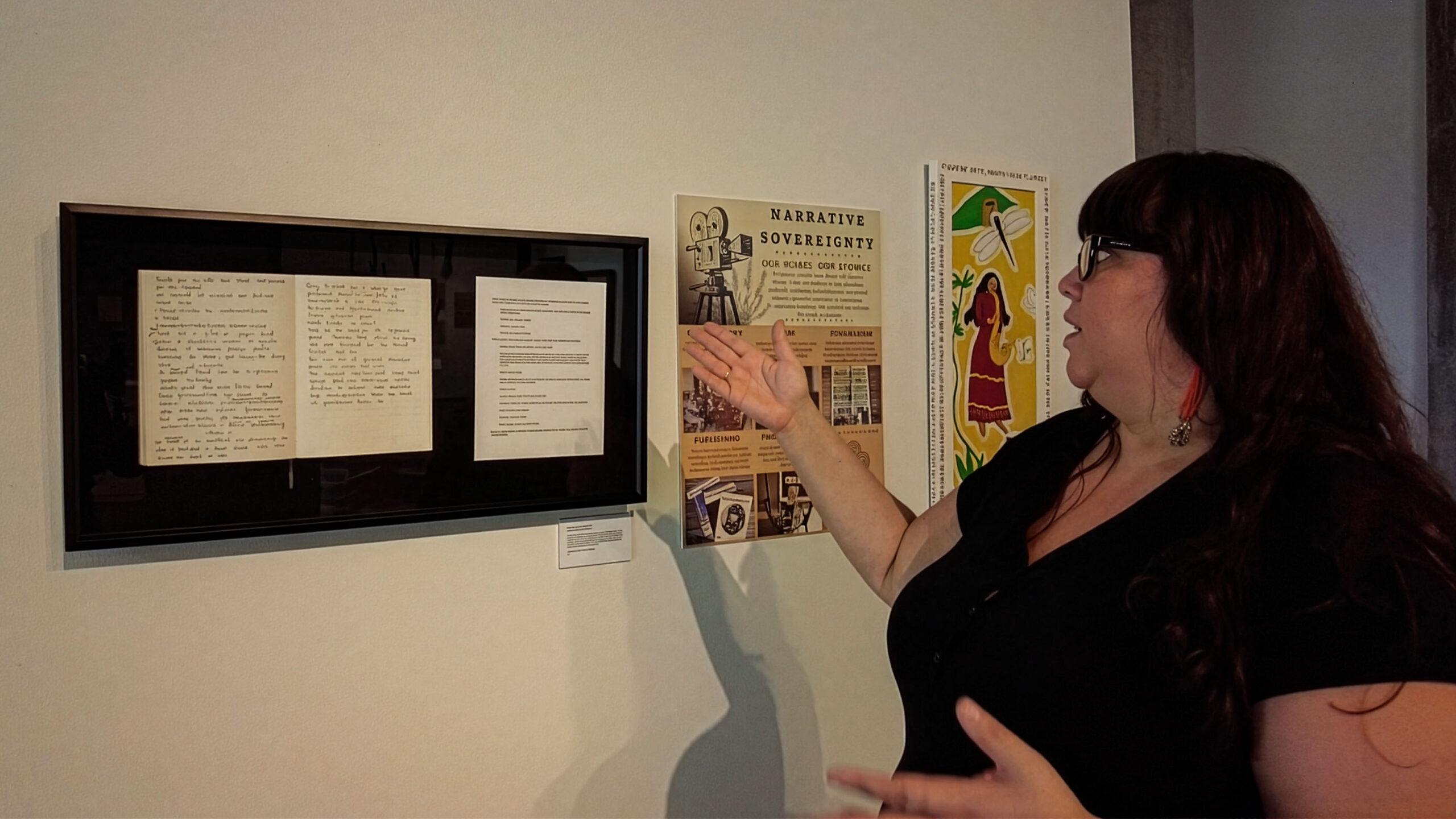
TULSA – Tribal sovereignty extends beyond treaties, court decisions, and laws. It is also carried through language, food, art, education, and the everyday words of Native communities.
That broader understanding of sovereignty is at the center of Still Sovereign: Land, Law, and Memory, an exhibition curated by Mvskoke citizen and artist Carly Treece.
The exhibition, on display at the Oklahoma Center for Humanities’ 101 Archer Gallery in Tulsa, examines Tribal sovereignty through contemporary and traditional Indigenous art, historical materials, and community knowledge. It is the first exhibition in Sovereignty and Democracy in Indian Country, a three-part series supported by a Mellon Foundation grant through the Oklahoma Center for Humanities at the University of Tulsa.
Treece said she hopes visitors leave with an understanding that sovereignty encompasses more than its legal dimensions.
“We know about treaties, we know about forced removal, we know about all of those things,” Treece said. “But I think a lot of things that the public eye doesn’t see are the people working behind the scenes and doing things every day to ensure that sovereignty remains.”
Treece pointed to language instructors and those working in food sovereignty and education as examples of people carrying that work forward.
The exhibition organizes its exploration of sovereignty around three themes: land, law, and memory. Treece said law represents an aspect of sovereignty many people are already familiar with through treaties, court cases, and news coverage. Land allows the exhibition to explore topics including land rematriation and co-stewardship with Tribal Nations.
Memory, she said, reaches into nearly every aspect of sovereignty.
“Memory is important because I feel like that is a part of everything that we do,” Treece said. “That’s in our DNA. That’s a part of our stories. That’s a part of our language, our food.”
The exhibition features Indigenous artists from numerous Tribal Nations and artistic disciplines, including Mvskoke artists Bobby Martin, Johnnie Diacon, and Kirk Morrison, as well as Treece herself. Other contributors include artists, writers, and knowledge keepers whose work ranges from language preservation and land stewardship to history and cultural continuity.
Treece said she selected artists whose work she admires and who bring strong voices and different relationships with their communities to the exhibition.
Using art to discuss sovereignty also provides audiences with a different entry point into subjects that are usually approached through history or law.
“Art just speaks to people differently,” Treece said. “Art is very subjective, so some people will look at something and have one thought, and it may be totally different from what the artist meant.”
Treece said those different interpretations can create space for dialogue.
Ultimately, she hopes Still Sovereign reminds visitors that Indigenous Nations and their sovereignty remain present and active.
“I hope that they come in and see the exhibit and know that we are still here,” Treece said. “We still have a big presence here, and that sovereignty is much more than what they see.”
Still Sovereign: Land, Law, Memory runs through Nov. 21 at the Oklahoma Center for Humanities, 101 E. Archer St. in Tulsa.
For Treece, the exhibition’s title summarizes its message for both the present and future generations.
“We’re still here, and we’re still going to remain,” Treece said. “And future generations are going to remain as well.