OKMULGEE – As the Muscogee (Creek) Nation works to improve how professionals recognize and respond to strangulation, its Attorney General’s Office is also developing changes to a criminal statute prosecutors say can make these cases difficult to prove.
The proposed revisions would remove language requiring prosecutors to establish an intent to cause great bodily harm and provide clearer definitions of strangulation and suffocation.
Melissa Roth (Choctaw), a domestic violence prosecutor for the Nation, said the current requirement creates challenges when victims have few or no visible injuries.
“I am definitely a proponent of removing the intent element,” Roth said. “I think any time a significant other or dating partner…is putting their hands on somebody’s throat and applying pressure, I think that that should be a crime regardless of what their intent was at the time.”
The proposed changes come as the MCN Center for Victim Services hosted two two-day strangulation prevention trainings on Oct. 5-6 and Oct. 7-8, bringing together law enforcement, prosecutors, medical professionals, victim advocates, and other responders.
Shannon Buchanan, violent crime services manager for the Center for Victim Services, said the training was designed to address gaps in recognizing strangulation and supporting survivors.
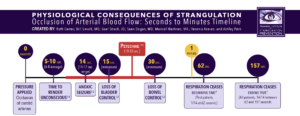
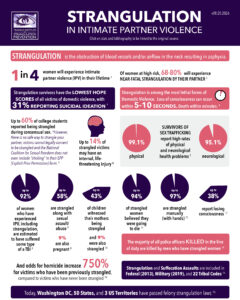
“More than fifty percent or more victims that were strangled do not have visible marks, at least in that immediate moment,” Buchanan said.
The training, funded through Office for Victims of Crime grants, covered medical symptoms, investigative documentation, trauma-informed responses, and prosecution.
Buchanan said officers sometimes believe they cannot pursue charges when a victim has no visible injuries. However, symptoms such as a raspy voice, difficulty breathing, or changes in consciousness may indicate strangulation even when external marks are absent. She emphasized the importance of follow-up examinations and interviews because some injuries may not become visible until hours or days after an assault.
The Center for Victim Services also works with MCN health facilities to help victims receive medical evaluations and continued assistance after an initial report.
“Advocates are really good at being a safety net,” Buchanan said, explaining that victim advocates provide longer-term support after law enforcement’s immediate response.
Under the Tribe’s current domestic abuse by strangulation statute, prosecutors must establish that strangulation occurred, that the defendant committed the act against someone within a qualifying domestic relationship, and that the defendant intended to cause great bodily harm.
Grace Carson, a visiting assistant professor at the University of Tulsa who teaches criminal law and federal Indian law, explained that the distinction involves mens rea, the mental state required for a criminal offense.
Carson said Oklahoma previously used language similar to the Nation’s statute but removed the intent-to-cause-great-bodily-harm requirement in 2023. The change means state prosecutors no longer have to establish the additional intent element to obtain a conviction for domestic abuse by strangulation.
For MCN prosecutors, Carson said, the law requires proof not only that the defendant intentionally committed the act but also that the defendant intended to cause great bodily harm.
The MCN Attorney General’s Office is working toward a similar change.
Roth said the revisions would also replace broader language concerning asphyxia with more specific definitions addressing strangulation and suffocation.
Deputy Attorney General Geri Wisner (Mvskoke) said the office reviews other jurisdictions’ laws and works with prosecutors to develop language suited to the Nation’s criminal code.
A timeline for introducing or adopting the proposed changes has not been confirmed.
Although strangulation can be fatal, prosecutors and legal experts explained that the act does not automatically meet the legal requirements for attempted murder.
Carson said attempted murder generally requires proof of a specific intent to kill, while strangulation offenses can apply without establishing that death was the intended outcome.
Roth said her office has pursued an attempted-murder charge in a case involving strangulation, but such charges are uncommon.
The evidence must make that distinction. Prosecutors must establish the defendant’s intent through statements, actions, and surrounding circumstances.
Another consideration is the federally imposed limitation on Tribal sentencing. Under enhanced Tribal sentencing provisions, the MCN can impose up to three years of imprisonment for an individual offense, subject to applicable legal requirements.
Roth said that limitation can influence charging decisions when a strangulation conviction and an attempted-murder conviction may carry the same maximum Tribal prison term.
Alexandra Fay, director of the Native American Law Center at the University of Tulsa, emphasized that differences between Tribal, state, and federal criminal codes reflect separate sovereign governments.
She said comparing maximum sentences alone can be misleading because Tribal governments operate under federal restrictions that do not apply in the same way to states.
Wisner expressed frustration with those limitations, arguing that the available sentences can be insufficient for serious violent crimes.
Buchanan similarly called for greater federal prosecution of violent and repeat offenders in Indian Country, where federal courts may have broader sentencing authority.
Beyond potential changes to the criminal code, prosecutors said specialized training can improve how cases are investigated and presented in court.
Roth said understanding the physical effects of strangulation helps investigators ask more detailed questions about breathing, vision, voice changes, and loss of consciousness.
“It’s really hard to prosecute something until you understand it,” Roth said.
Buchanan emphasized that responding to strangulation requires more than criminal charges. Victims may need medical care, safety planning, financial assistance, and continued advocacy.
Wisner said advances in medical knowledge and investigative practices should inform the Nation’s ongoing review of its laws.
For victims of violent crime living within the Mvskoke Reservation, the Center for Victim Services provides assistance regardless of Tribal affiliation.
Its 24-hour crisis line is available at 918-732-7979.