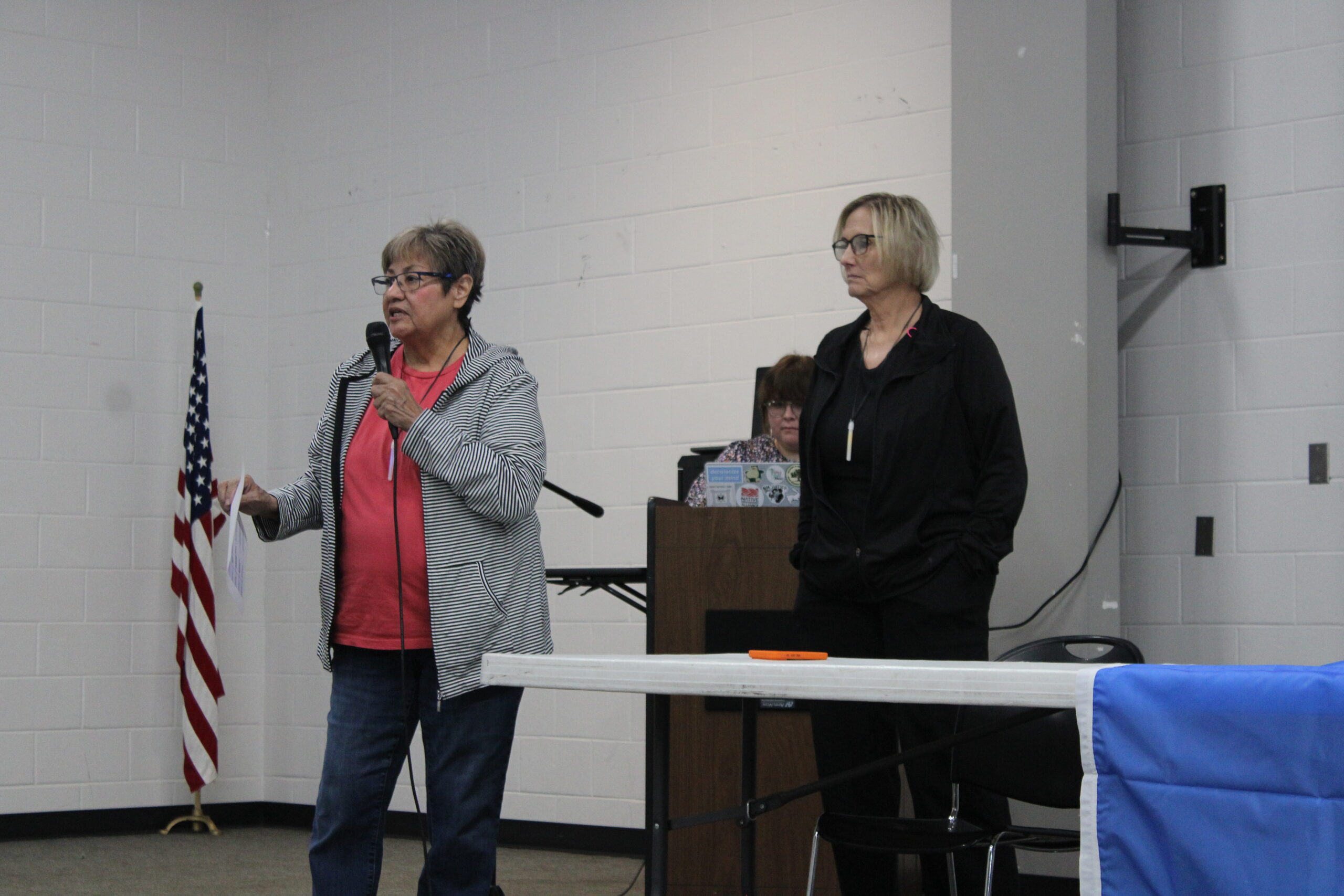
“I don’t see transparency with our leaders that I think we deserve.” – Pat Kaseca
MUSKOGEE – Activist Mackenzie Roberts (Mvskoke) is tired of fighting data center developments, but she isn’t slowing down. After tracking projects on the Mvskoke Reservation and beyond, Roberts is helping others organize against developments in their own communities. She shared strategies for mobilizing opposition groups at the Muskogee Data Center Town Hall on Thursday, Oct. 15.
Two new Google data centers in Muskogee County will be located at Summit Hill and Council Hill. Google announced an energy agreement with Oklahoma Gas and Electric on Thursday, April 30. A construction timeline for the data centers has not been made public.
Roberts works with Stop Data Colonialism, a national Indigenous coalition with Honor the Earth. Based in Deer Lane, Montana, the coalition conducts research and invests in Indigenous communities.
Roberts is also the founder of SACRED Inc., an organization designed to meet community needs in the Southern Region of the Mvskoke Reservation. She has played an active role in informing fellow community members about the strain on environmental resources caused by data centers.
She is now mobilizing others to organize town halls in their own communities. This involves important steps such as organizing a community petition, learning where to submit petitions, and filing Freedom of Information Act requests.
According to Roberts, fighting data centers can give the community a sense of power. Although the work is hard, she said that meeting new people and sharing information make it worth it.
“I just learn, I teach myself, then I teach people what I know,” Roberts said. “A data center is not a chicken house. It’s not a barn. It is not akin to anything like that because the amount of landmass that it consumes in resources is completely incomparable.”
Pat Kaseca (Mvskoke) and Debbie Rowan organized the Muscogee Data Center town hall. Both live in Muskogee and have their own concerns about data centers being built. Both spoke about the lack of transparency from Muskogee city leaders regarding the Google data centers.
“It’s not that we’re against data centers, but when you have local leadership that seems to be keeping us out of the loop, not wanting to give us answers, my spidey sense goes up,” Rowan said.
Kaseca and Rowan have spoken at Muskogee City Hall meetings, albeit with difficulty getting placed on the agenda. According to Rowan, if community members are not placed on the agenda, city council members do not have to answer their questions.
For Kaseca, this is not the first time she has made her voice heard at a city hall meeting. She fought the placement of a marijuana dispensary that was planned to be built three blocks away from her home.
Kaseca said she has invited representatives of the Muscogee (Creek) Nation National Council to the town halls. According to Kaseca, no representatives have attended a meeting yet.
Mvskoke Media reached out to Mvskoke District Representatives Mary Crawford and Lora Harjo-King for comment on the data centers in their district. Rep. Harjo-King responded that many Mvskoke citizens are unaware of data centers in their district.
“Citizens were unaware and concerned. The Nation did develop a task force to address the tribes stance. They still have 20 days,” Harjo-King said in an email to Mvskoke Media.
Among the town residents who attended the meeting was Mvskoke artist Dana Tiger. Her concerns include the data centers’ environmental impact, their strain on natural resources, and their effects on cognitive health. For Tiger, this was her first time attending a meeting on the issue.
“I’m just trying to see where I can be involved and get the word out,” Tiger said. “I want to learn what the word is and spread it so people can know the impacts and do whatever it takes to stop this. It’s no good for the community.”
Tiger described the data centers as “machine-driven.” She is concerned about the way data center-powered artificial intelligence is being used to generate art.
Oklahoma Tribes, including the Cherokee Nation, the Seminole Nation, and the Cheyenne and Arapaho Nation, have passed moratoriums on data centers. In November 2025, the MCNNC denied approval of a proposed data center in Beggs, the Mvskoke Technology and Innovation Park.
FluidStack, a tech company that helps build and run massive data centers and works with Google and Anthropic, announced a $7 million donation to schools in Okmulgee County. This includes Okmulgee County public school districts, Green Country Technology Center and OSUIT.
Alston Construction, the company contracted to build the FluidStack data center, recently donated to the MCN Department of Education and Training. The donation was used to purchase back-to-school supplies, which were distributed at an event held at the Mvskoke Dome.
Roberts has spoken on the Fluidstack data center with Okmulgee residents and also at a petition kickoff on Monday, Aug. 10, at the College of the Muscogee Nation.
According to Okmulgee County Floodplain Administrator Jeff Moore, the FluidStack data center was approved for a floodplain permit on Friday, Oct. 16. With the current approved permits, construction on the FluidStack data center can begin in certain areas.
The Brockovich AI Data Center Reporting website tracks data centers and publishes their locations. The map shows 15 data center sites reported on or near the MCN Reservation. It also shows two data centers are under construction, and two have been proposed.
To view the Brockovich AI Data Center Reporting website’s map of data center sites in the United States, go here. The map was last updated Sunday, Oct. 4. Data center locations are compiled from Compute Atlas, Epoch AI, news reporting, and public filings.