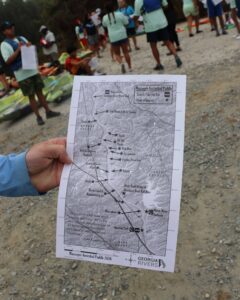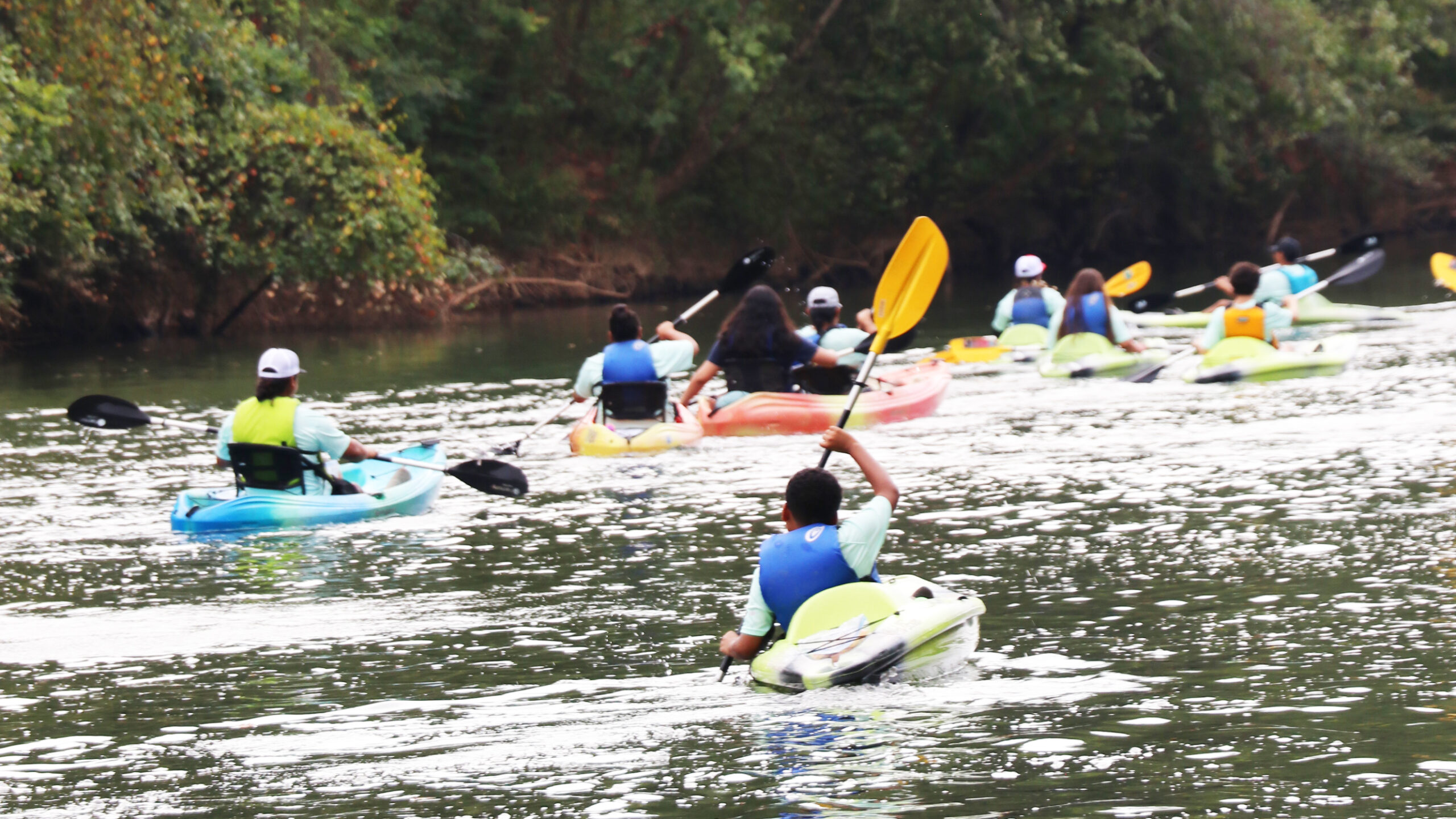
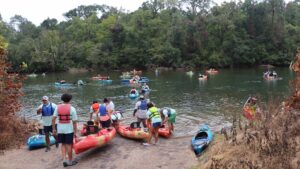
OCMULGEE – On September 13, the Creek Ancestral Paddle Journey began on the Ocmulgee River in Georgia. It was the largest group of Mvskoke paddlers to set out on these waters since the Removal. The journey brought together numerous collaborators and involved months of preparation, cultural learning, and an opportunity for participants to reconnect with history and ancestral waterways.
Dr. Monte Randall (Mvskoke), President of the College of the Muscogee Nation and the CEO of Sons of Mvskoke, discussed how the journey came together and the history behind the effort to return to the Ocmulgee River.
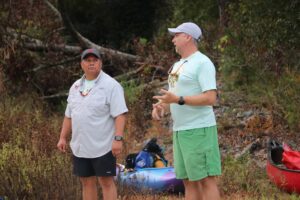
The idea began several years ago through Sons of Mvskoke. In 2024, the organization received a Homelands Grant and traveled to the Ocmulgee Mounds in September for the Ocmulgee Indigenous Celebration. The organization continued its regular programming and stickball camps before eventually returning to the idea of an ancestral paddle journey.
Georgia Rivers, a Georgia nonprofit organization, connects people with the state’s riverways. Since its founding, the organization has worked to keep Georgia’s rivers and streams open to the public while protecting existing recreational uses and promoting the freedom to float.
“This marks the first time since their removal in the 1800s that members of the Muscogee Nation have floated the river in such large numbers. We hope it is the first of many paddles planned to reconnect the Muscogee with the rivers of Georgia that still bear the names given by the river’s original keepers,” Georgia Rivers said.
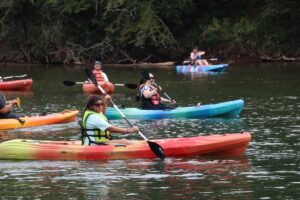
“We as people were on those waterways, we communed with those waterways, we harvested resources, we gave back and took care of those waterways, so that’s why we wanted to really return to that Creek Ancestral Paddlers,” Randall said.
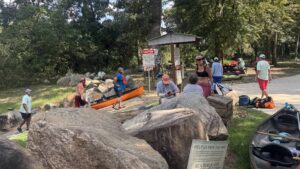
Before entering the water, participants took part in a cultural blessing. Throughout the journey, the group encountered a historic fishing weir, muscadines, and river cane. Participants also had an opportunity to swim and enjoy time together on the river.
According to Randall, the fishing weir was a rock formation created by the Mvskoke people to funnel fish. A basket would be placed at the end of the formation to collect the fish. Randall explained that the structure allowed people to harvest fish without impeding the river.
Once the journey ended, the tired group gathered to reflect on the day and finished with a Mvskoke hymn and a prayer.
Reconnecting with the history of the waterways
Over the years, questions arose about the Ocmulgee River and its waterways, prompting further research. Randall said they began examining the name Muscogee (Creek) Nation and the stories surrounding the history of the Mvskoke people.
“The English settlers called us first ‘the Ochese Creeks’ because that’s where they would go, that’s where we would meet up to trade. Then later just ‘Creeks.’ That’s kind of the beginning of being called ‘Creeks.’”
The research eventually expanded into the historical purposes and functions of waterways, including fishing, natural resources, transportation, economics, and warfare.
“So we looked into that and started looking into the purposes, the functions of all that being on the waterways: fishing, natural resources, transportation, economics, warfare. There were a lot of these things that were seen in the history books,” Randall said.
Randall explained that the organization wanted to reconnect with those waterways, particularly in Georgia and Alabama, which still bear the names associated with the Tribe. From there, the research expanded to dugout canoes and the traditional paddles as they worked towards a deeper understanding of Mvskoke ancestral canoe culture.
That research continued into late 2025, when Randall wrote another grant with Native Voices Rising to support a canoe camp. The camp was intended to help participants reconnect with Mvskoke culture and explore the history and traditions of traveling by canoe on the water.
Randall explained that organizing a water journey required significant resources, including planning, leadership, teamwork, and communication. Whether participants are canoeing, rafting, or kayaking, those same skills and logistical considerations are necessary to make a journey possible.
“All of those aspects of ‘what is it’, ‘what is this canoe culture for us,’ ‘what is this water or Creek culture for us.’ As we know, after removal, we were removed to a different set of waterways and had different functions and had different characteristics about them. That canoe culture transitioned; I don’t want to say we lost it or it went away, it may have went dormant because of society and where we were at that time,” Dr. Randall said.
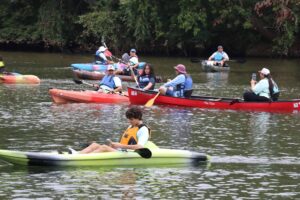
“This really returned to that culture; this really is highlighting all of those skills that go around of what it takes to put people on the water and what it takes for people to navigate the water, so that was what this was about.”
The journey provided participants with an opportunity to connect with that culture. This year, more than 40 people participated in the paddle.
Building partnerships and preparing for the journey
Along their journey, the group was joined by a video production crew funded by a grant from the Sons of Mvskoke. The production is a collaborative project, and Randall said he doesn’t have a timeline for completion.
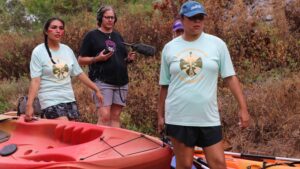
Mvskoke artist Maddie Sanders created the journey’s symbol and shirt designs. Randall said he appreciated her past artwork and wanted her to create something specifically for the trip.
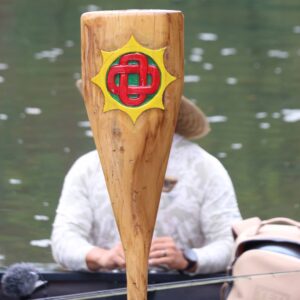
Sanders had previously created artwork for Georgia Rivers. For the new designs, she attended the canoe camp and spoke with participants about the project and the designs. Randall also praised her work in creating the group’s logo.
The partnership with the College of the Muscogee Nation, Muscogee (Creek) Nation Culture Preservation, the Mvskoke Nation Youth Services, Georgia Rivers, and Sons of Mvskoke developed when the Sons of Mvskoke received the grant for the canoe camp.
Safety was also a major part of the preparation. Before setting out, organizers conducted swim tests for the paddlers and adults. Randall said the tests helped ensure participants felt comfortable in the water and helped organizers assess their swimming abilities.
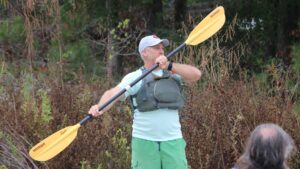
Participants registered and provided information about their physical abilities and previous water experience, including kayaking, paddling, and swimming. Randall said most participants fell within the intermediate swimming range. Everyone was also provided with personal flotation devices (PFDs).
“Just to further ensure safety, we had a swim test, and Mvskoke Nation Youth Services James Bender, and Youth Services had coordinated that at the Okmulgee YMCA. We tested everybody and helped them out, and everybody passed. We had a good swim day out there as well,” Randall said.
Randall said he initially reached out to Mvskoke Nation Youth Services Director James Bender after attending a presentation in which Bender spoke about the Youth Council’s participation in the Ocmulgee Indigenous Celebration. He then contacted Bender to see if he wanted to partner with the Sons of Mvskoke on the grant.
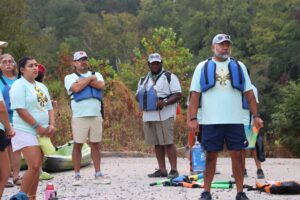
Sons of Mvskoke was already working with Georgia Rivers, and those discussions eventually led to the organization of the paddle journey. By early summer, Georgia Rivers had agreed to help with training.
As the partnerships developed, CMN’s Natural Resources and Extension Program and Environmental Science Club also became involved. Randall felt their participation was a natural fit because of the focus on waterways and their experience working with water-related projects in Oklahoma. They were also able to begin testing the waters to help ensure participants’ safety.
CMN’s Natural Resources program also planned to harvest river cane and hickory wood in Oklahoma. However, during the trip to the Homelands, Randall wanted the Natural Resources team to help participants learn about and gather resources such as muscadines and persimmons, as well as other available plants.
CMN also helped with the historical and cultural lessons during river visits. Randall initially asked Georgia Rivers to assist with some of those discussions, but the organization referred them to MCN Culture Preservation to help lead the cultural conversations.
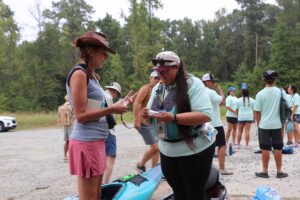
Learning about Mvskoke canoe culture
When asked what he enjoyed most about the journey, Randall pointed to the opportunity to learn about canoe culture, the different styles of canoes, and the history and research surrounding them.
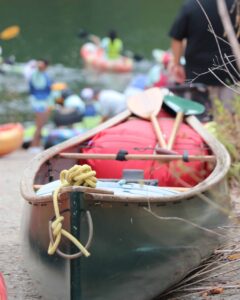
“We had canoes for transporting goods, people had singles and double, and for daily transportation. Then there were war canoes that carried the warriors. Our people traveled all the way down to the coast, down to the oceans, to the Atlantic and the Gulf, we had sails to travel back upstream. It’s just really amazing to see, to learn about this culture that existed and it is ours,” Randall said.
Beyond the physical journey, Randall hopes participants will remember their connection not only to the land but also to the waters of Georgia and Alabama.
“That it’s still flowing, we’re still here, even though we’re in Oklahoma, we’re still on this earth, we’re still rooted here and just as those water flows today, that connection is still there and available for us all to reconnect. I hope that more people would want to take part in this as well,” Randall said.
Looking toward future journeys
Randall said Sons of Mvskoke has developed a good partnership with Georgia Rivers and hopes to continue working together. He appreciated the experience and knowledge Georgia Rivers brought to the project.
However, Randall acknowledged that the current effort relies on grant funding, continued support will be necessary to keep the journeys going. He hopes the paddle trips can eventually become an annual event and plans to continue searching for grants to support future trips.
Randall said he would like to coordinate an annual paddle on the Ocmulgee River around the same time as the Ocmulgee Indigenous Celebration. He is also considering additional trips throughout the year to other waterways, including the Chattahoochee, Etowah, and Oconee rivers.
Randall expressed gratitude to the organizations and individuals who helped make the journey possible, including Native Voices Rising, Georgia Rivers, Ocmulgee Outdoor Expeditions, the Ocmulgee Mounds and Park, MCN, and everyone involved in the partnership.
He emphasized how meaningful the experience was, particularly in seeing the leadership, teamwork, and collective effort required to bring people together for a journey on the water.
Those interested in learning more about future journeys or participating can contact Sons of Mvskoke at eppucetake@gmail.com