

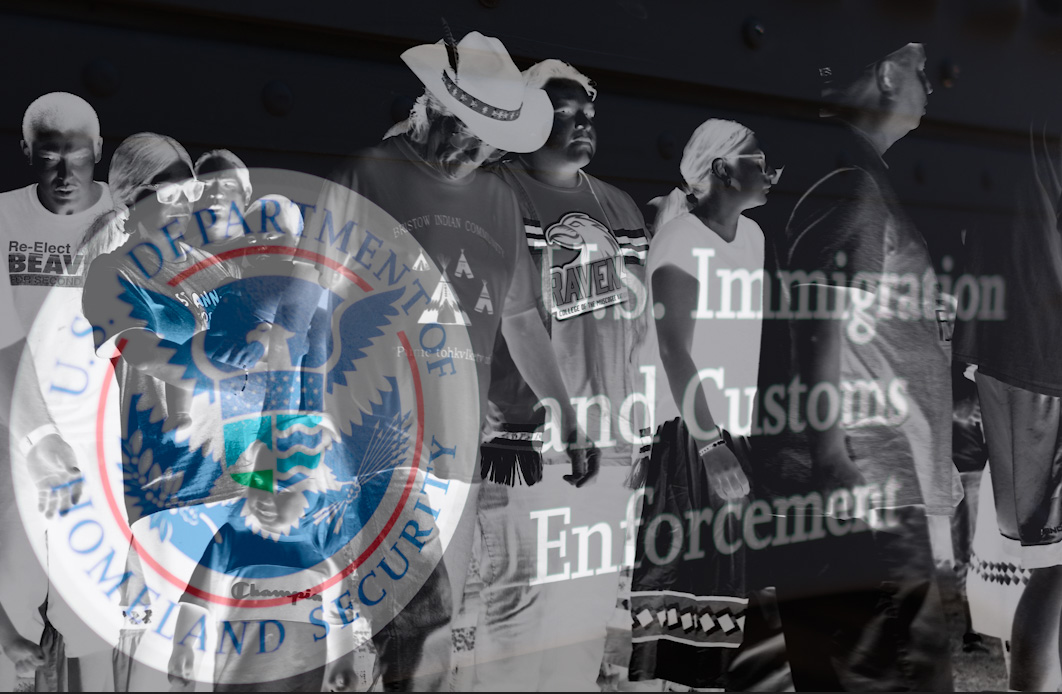
MVSKOKE RESERVATION – Reports of U.S. Immigration and Customs Enforcement (ICE) stopping and detaining Tribal citizens continue to unfold in Indian Country. Tribal leaders from the Five Tribes and various Native American nonprofits have condemned ICE’s actions and have provided resources on what to do if an ICE agent stops a Tribal citizen.
ICE has expanded its agency and seen a significant increase in its operating budget since President Trump took office in 2025. Tensions among the public and ICE have increased since agents shot and killed two U.S. citizens in Minneapolis. Renee Good was shot by ICE officer Jonathan Ross on Wednesday. Jan. 7. Alex Pretti was shot by an unnamed ICE officer on Saturday, Jan. 24. Reports of ICE agents detaining four Tribal citizens from the Oglala Sioux Tribe on Thursday, Jan. 8, have been condemned by Tribal government leaders. An ICE detainment of a Diné citizen, Peter Yazzie, was scrutinized and described as “unlawful” by Arizona state leaders. In a public statement made on Sunday, Jan. 25 by the Standing Rock Tribe, they announced that one of their Tribal citizens had been detained but was released.
In Oklahoma, Operation Guardian Sweep has been in effect since it was announced on Monday, September 29, 2025. The joint operation between the Oklahoma Highway Patrol and ICE has conducted targeted enforcement actions along Interstate 40.
Oklahoma tribes, including Absentee Shawnee, Chickasaw, Cherokee, and Muscogee (Creek), have issued statements on the issue of ICE detaining Tribal citizens. The United Indian Nations of Oklahoma (UINO) issued a travel advisory to Tribal citizens amid the expansion in federal immigration enforcement. UINO’s statement reads:
Thirty-eight federally recognized tribes are headquartered in Oklahoma, and Tribal citizens from hundreds of Native nations call this state home. It is deeply concerning that Tribal citizens have been questioned or detained despite their lawful status. Given these developments, there is no reason to assume Native people in Oklahoma could not or are not already facing similar encounters. We strongly urge all Native people to carry any Tribal, state, or federal identification available to help protect themselves and their families.
NARF Legal Guide
The Native American Rights Fund (NARF), a nonprofit that provides legal assistance to Tribal citizens, released a detailed guide on what to do if ICE approaches a Tribal citizen. If in public, NARF recommends remaining calm, avoiding physical resistance, and not lying when questioned. Tribal citizens have the right to remain silent and may verbalize something to the effect of “I am exercising my right to remain silent.” They also have the right to request to speak with a lawyer.
It is recommended that Tribal citizens carry a Tribal or State Real ID to prove U.S. citizenship. Not all State IDs are enough to prove U.S. citizenship. If an ICE agent does not accept a Tribal ID, request to speak to their supervisor.
ICE agents are not always clearly identified. Some agents have been reported to wear unmarked clothing or to drive unmarked vehicles. ICE agents have also been spotted wearing clothes that say “POLICE.” For those approached by a law enforcement officer, it is their right to ask the officer for their identification.
According to NARF, ICE agents cannot legally enter a private residence without a valid judicial warrant signed by a judge. An ICE agent issues an administrative warrant, which is not the same as a judicial warrant issued by an immigration judge.
According to the Fourth Amendment of the United States Constitution and decades of legal precedent, law enforcement may enter a private residence only with a warrant issued by a judge. However, according to a leaked memo by Acting ICE Director Todd Lyons, ICE agents have been directed to use administrative warrants to forcibly enter private residences. The leaked memo was published by the legal nonprofit, Whistleblower Aid, on Wednesday, Jan. 21.
Whistleblower Aid asserts that entering a private residence without a warrant is a violation of the Fourth Amendment. According to a public statement by Whistleblower Aid Senior Vice President and Special Counsel David Kligerman, the Fourth Amendment was designed to prevent abuses such as forced removal and trespass.
“No court has ever found that ICE agents have such legal authority to enter homes without a judicial warrant,” Kligerman said. “This administration’s secretive policy advocates conduct that the Supreme Court has described as ‘the chief evil against which the wording of the Fourth Amendment is directed’ – that is the warrantless physical entry of a home.’ This is precisely what the Fourth Amendment was created to prevent.”
A complete list of valid judicial warrants can be found at nilc.org. NARF warns that if ICE agents enter a private residence without the resident’s permission or without a valid judicial warrant, they should not physically resist or obstruct their search. Resisting and obstructing could subject the resident to potential criminal charges.
If ICE approaches a Tribal citizen in their car or in public, they have the right to ask if they are being detained. If a Tribal citizen is not being detained, they should be free to go.
According to NARF, ICE agents have stopped cars and approached citizens based on their perceived ethnicity. If in a vehicle, drivers must roll down their windows upon request by an ICE agent. Drivers are required to present their driver’s license if asked; passengers are not required to provide personal information. If an ICE agent requests a driver or passenger to step outside of the vehicle, it is the driver or passenger’s right to ask why. ICE agents can only search a car with a valid judicial warrant.
It is not illegal to record an ICE agent performing official duties; however, NARF advises doing so at a safe distance and without physically obstructing an ICE operation. At any time an ICE agent searches a residence or car without a valid judicial warrant, the resident or driver has the right to say, “I do not consent to a search.”
ICE agents can enter a public workspace without a warrant. Public workspaces include office lobbies, supermarkets, retail stores, or dining areas. ICE agents cannot enter private spaces, such as employee-only areas, without the employer’s permission or a valid judicial warrant.
ICE Detainment
NARF advises that, if ICE detains a Tribal citizen, they communicate any known medical issues or any arrangements that need to be made for childcare. If an ICE agent does not speak the detainee’s language, request an interpreter. If the detainee is a U.S. Citizen, say, “I am a U.S. citizen,” and ask why they are being detained.
ICE has detained minors. NARF asserts that minors have the same protections as adults and have the right to remain silent or request to speak to a lawyer. Minors are not legally required to carry identification unless they are operating a vehicle. If a minor is carrying identification, it should be done only with safeguards, such as in a sealed document labeled “Confidential legal documents.” If detained, minors have the right to remain in contact with their parent or guardian.
For those who believe they are at risk of ICE detainment, it is recommended that emergency contacts be identified and memorized. It is also recommended to make arrangements for children in case their parents may be detained.
When a detainee is released, NARF advises them to write down their encounter with ICE. Include details like officer names, badge numbers, and anything that was said or done during the encounter. The released individual should discuss the information with an attorney.
The Muscogee (Creek) Nation released a public statement on Saturday, Jan. 17, regarding ICE activity within the state. Tribal citizens are advised to carry Tribal documents, such as their MCN citizenship card or Certificate of Indian Blood Card. The statement reads:
We have confirmed that officials from the federal immigration agency ICE are now in Oklahoma. Please be advised that the Muscogee Nation is monitoring the situation to ensure the safety of our citizens both on and off the Reservation. Citizens are encouraged to keep their tribal identification with them as accessible. Should you be contacted by ICE, remain calm, respectful, and know your rights.
In response to concerns about ICE activity in Indian Country, NARF is hosting a free 60-minute “Know Your Rights” webinar, followed by a 30-minute question-and-answer session. The webinar will provide clear, practical information on what to do if you are approached by an ICE agent at home, in your car, or in public. It will also provide policy and government-focused framing on what Tribal Nations can do for their Tribal citizens. Those interested in the webinar can register here.
The Muscogee Nation Lighthorse Police Department dispatch has direct access to verify citizenship for any Mvskoke citizen, regardless of whether they have been stopped on or off the Mvskoke Reservation. Lighthorse Police Department can be reached at (918) 732-7800.
Native American citizens who believe an ICE agent has violated their rights in any capacity may contact NARF at 303-447-7776 or by email at info@narf.org.




I’m old and 3rd paragraph had to fact check the sioux story . apparently the tribes leadership walked back those comments.
so why didn’t we note that in article
“Reports of ICE agents detaining four Tribal citizens from the Oglala Sioux Tribe on Thursday, Jan. 8, ”
personally support ice. illegal aliens should go apply for citizenship just like everyone else.