This story is our fourth in a series by the Mvskoke News team focusing on climate solutions on the Mvskoke Reservation. This year, Mvskoke Media has been part of the Climate Beacon Newsroom Initiative, a collaboration between the Indigenous Journalists Association and the Solutions Journalism Network. Solutions journalism rigorously examines evidence-based individual, group, and community responses to social problems. The initiative supported our newsroom’s skills development in story production, specifically stories focused on responses to climate and environmental challenges.
OKMULGEE – Shelby Lofton has special memories growing up with a native pecan grove on her property. It had many trees, with plenty of pecans to pick and shell. Now an adult, Lofton gets to teach others about planting pecan trees and the importance of self-reliance in growing crops and practicing food sovereignty.
“I was always the kid to go out, collect the pecans, crack them, and help make the homemade pecan pie for Thanksgiving,” Lofton said.
Lofton serves as the Federally Recognized Tribal Extension Program (FRTEP) educator for the Muscogee (Creek) Nation, planting seeds of knowledge in others about how to be good stewards of the environment. According to Lofton, she is one of 37 FRTEP educators in the U.S. who work closely with Tribes to promote these values through 4-H agriculture programming.
One of the programs Lofton’s department oversees is the Mvskoke 4-H Ocmulgee Club, a collaborative effort with the College of the Muscogee Nation Extension Program. The group blends Mvskoke culture, language, and traditions with hands-on gardening projects. The projects teach important, tactical lessons on growing food and its role in Tribal food sovereignty.
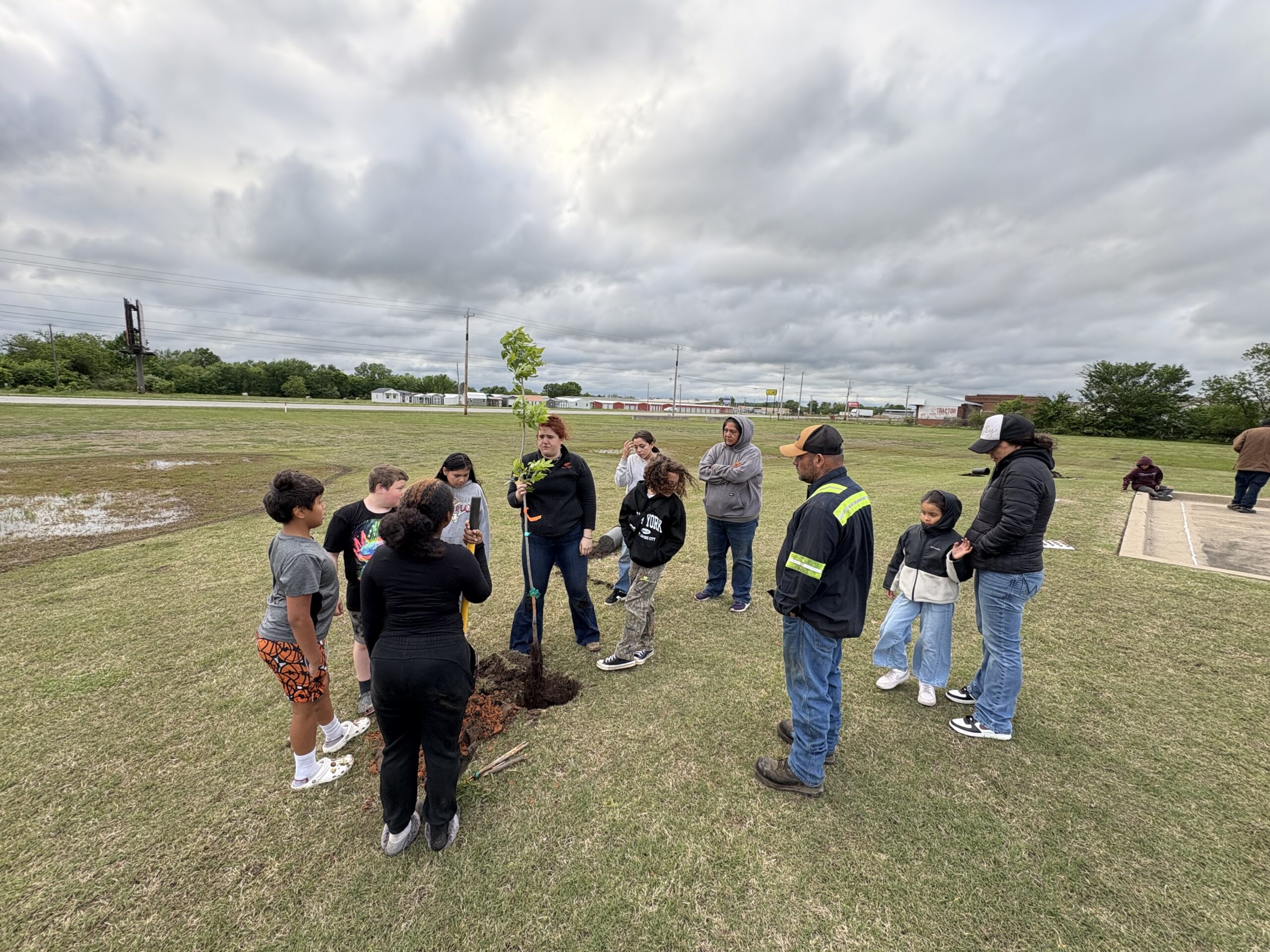
A project this spring saw Lofton and the Mvskoke 4-H Ocmulgee Club students planting two oce entvkacketv, or pecan trees, at MCN Food Distribution.
According to Lofton, MCN Food Distribution is located near a pecan grove and is an area proven to support mature trees. Lofton’s group of students toured the MCN Food Distribution and learned how the department serves citizens. Then came the time to go outside and start digging.
“They were really excited to get their hands in the dirt,” Lofton said. “First, we talked a little bit about the different varieties of pecans that grow. We got the trees out of the containers, untangled the roots, and dug the holes. The kids dove right in.”
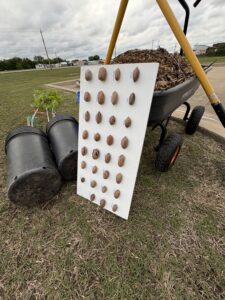
Lofton taught students using a board displaying different pecan species. The board illustrated the different shapes of each pecan species.
According to the U.S. National Science Foundation, tree planting can offset emissions that contribute to climate change. In the United States, trees face threats from fire, drought, and insect damage, all exacerbated by climate change. Experts warn these risks will become more widespread by 2099. An interactive map featured on the National Science Foundation’s website illustrates regional risks to trees over the next century.
“Pecan trees are really subject to environmental stress,” Lofton said. “Temperature changes can stress them out, drought, other things like insects and pests can be real bothersome on pecan trees.”
The goal of the Mvskoke 4-H Ocmulgee Club is to provide enriching programs that teach students to be good stewards of the environment. Students are empowered with skills such as pecan tree planting that help address climate change.
Just like tree saplings, knowledge is spread out in the hope that one day a student will take the initiative to grow and maintain their own pecan tree.
A native crop
The seeds for the Mvskoke 4-H Ocmulgee Club were provided by Oklahoma State University Senior Extension Specialist Dr. Becky Carroll. Working with pecan growers and Tribes around the state, Carroll conducts master gardening lectures, empowering others to grow their own crops.
In addition to its environmental usefulness, pecans also have tremendous health benefits. According to heart.org, they provide healthy fats, protein, fiber, vitamins, and minerals. They are a good source of zinc, thiamin, and manganese. Carroll pointed out that pecans have the highest antioxidant levels of any other nuts found in the United States.
“Pecans are actually very, very healthy for people,” Carroll said. “Until just a few years ago, people didn’t understand the health benefits of eating pecans. And so, in the last several years, they’ve actually been able to receive the American Heart Association’s little heart check, their little certified product.”
Pecans are native to Missouri, Kansas, Arkansas, Texas, Louisiana, and Oklahoma. For generations, Indigenous people in these areas, including the Mvskokvlke, have benefited from pecans.
“They were important for Native American Tribes that were here, those Indigenous people. They use them for trade and also for sustaining health. It’s (pecans) a very good source of energy and protein,” Carroll said.
Carroll affirms that almost anyone with land can grow a pecan tree. Pecan trees need to be planted in pairs to cross-pollinate. One tree acts as an early pollen shed, the other, a light pollen shed. This ensures that the trees receive effective cross-pollination, resulting in robust pecan production.
MCN Food Distribution
During the 4-H Ocmulgee Club’s field trip to the MCN Food Distribution, students were given a presentation by Farm Manager Melissa Welch (Mvskoke). Her job is to educate students at the College of the Muscogee Nation and Elders about food sovereignty initiatives, such as cultivating plants or starting gardens. Welch’s gardens feature a wide variety of produce, including squash, corn, and tomatoes. Her department provides food packages and recipes for citizens. Welch hopes the packages and recipes will encourage clients to try something new.
Welch provided 4-H students with a trail mix of fresh ingredients like cranberries and peanuts. Her favorite part of homegrown snacks is that they do not contain added chemicals or sugar.
Welch explained that Pecan trees can be planted by anyone, and they are a long-term investment. Welch said teaching tree planting is important because there is no telling what shape the environment will be in by the time the saplings reach full maturity.
“It’s important to plant those (pecan trees). It’s important for the next generations upcoming to see that because if they don’t start planting now, by the time they’re young adults or even in their 30s, there may not be many pecan trees due to elements of the environment and development,” Welch said.
Limitations
According to Carroll, pecan trees are difficult to spray for disease and pests because of their large size. Additionally, trees need ample space between them, at least 40 feet apart. If trees have too much shade, they can lose limbs. Carroll discourages homeowners from planting pecan trees close to homes or other buildings.
One of the biggest threats to pecan production is the pecan weevil, a tiny insect that infests crops. Female pecan weevils lay their eggs in pecans once it reaches its early dough formation. Pecan weevil infestations in Oklahoma typically occur after heavy rainfall events in late July, August, and into September. Just like the pecan tree, Carroll shared that pecan weevils are also native to Oklahoma.
“If anyone has ever found a pecan on the ground that has a perfectly circular hole in that shell, that’s showing you where the pecan larva is,” Carroll said. “The egg was laid inside that pecan; it has eaten the kernel, then they chew a perfectly circular hole, squeeze out, go into the ground, and start the whole process over.”
Squirrels and crows can also cause headaches for pecan production. Carroll said just one squirrel can take a pound of pecans a day.
Pecans have a shelf life. If they sit at room temperature for three months, their quality begins to decline. To extend their shelf life, pecans need to be kept in a refrigerator or freezer.
Welch warned that managing pecan trees is hard work. Pruning, trimming back the root system, and watering are necessary for healthy growth. According to Welch, patience is a necessary virtue for pecan tree growers.
“It’s not going to produce a pecan the following year. It takes about six to seven years to be able to produce for any kind of nut or fruit-bearing tree,” Welch said.
Although the pecan tree’s journey from sapling to fully-mature adult is a long one, it is one that can reap benefits for its grower. Pecans can be consumed and prepared in many different ways, including desserts, salads, or fresh out of the shell.
Welch enjoys eating them fresh after they are cracked open. Carroll enjoys baking pecans in a pie or sprinkling them on her oatmeal in the morning. Loften also enjoys consuming them in dessert form.
“I like them in pies too. Just a regular pecan pie. A traditional pecan pie is my staple. I’ve got special memories attached to pecans,” Lofton said.
By educating students in the 4H program about stewardship and tradition, Mvskoke people continue to fight for food sovereignty and enjoy the benefits of their labor, such as pecans. Some may even aspire to be extension educators, like Lofton, who continue to share their skills and passion with others.