DECATUR, Ga. — The fight to save a historic plot of land in Decatur, Georgia, from a controversial construction project has ended in victory with the help of the Muscogee (Creek) Nation.
The land was once home to a vibrant Black community known as Beacon Hill, but even before Beacon Hill, it was Mvskoke land.
After the Civil War, free African Americans settled the one-square-mile area now known as the Beacon Hill Historic District near downtown Decatur. Beacon Hill had its own businesses, churches, schools, and residences that served the Black community during segregation.
However, in the 1960s, Beacon Hill came under bureaucratic attack. The city of Decatur declared the neighborhood a “slum” and began a process it called “urban renewal.” Beacon Hill was then demolished to make way for a public housing apartment complex called Allen Wilson Terrace. The residents were forced out. Schools, businesses, churches, and homes were all closed and destroyed. Beacon Hill was virtually wiped off the map.
In 2014, Allen Wilson Terrace was also demolished, and in 2017, City Schools of Decatur purchased the land.
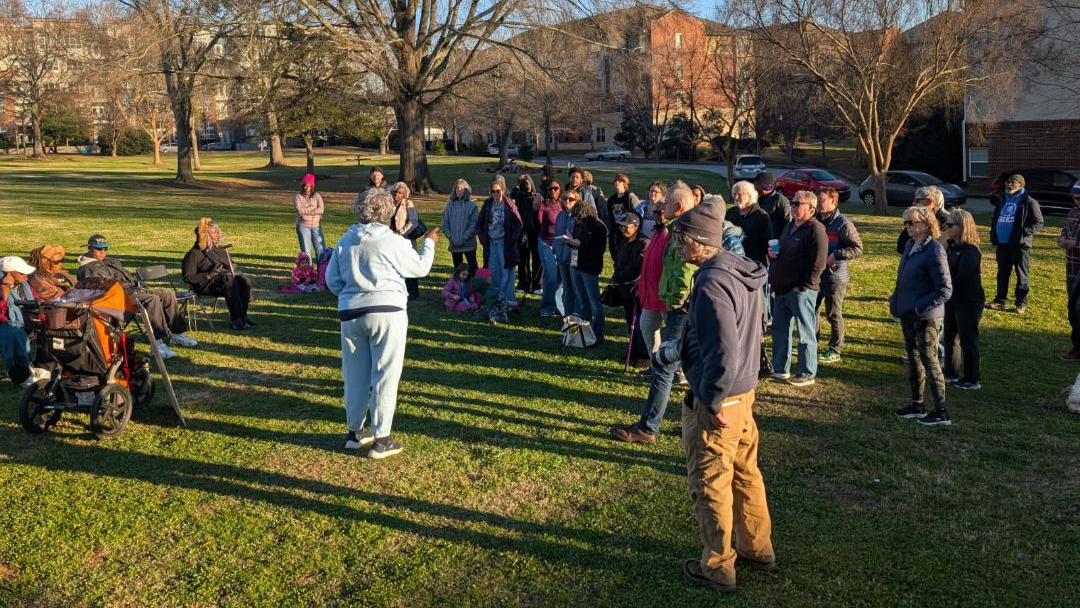
Since the demolition of the housing complex, the land has been used as a community greenspace. By 2023, the greenspace had become home to Decatur Day, an annual community celebration, at the city’s request. This also allowed the remembrance of Beacon Hill, a keystone of Decatur Day, to be front and center.
City Schools of Decatur began eyeing the plot for the construction of an early childhood learning center in 2024, with surveying having already begun by 2026. Decatur Schools Chief Operations Officer Jarvis Adams said the project was “shovel-ready.”
In a Feb. 24 public meeting of the Decatur Historic Preservation Commission, Emory University Indigenous Studies Professor Emil’ Keme referred to the land as “sacred ground,” saying, “When we talk about history, we often talk about buildings, documents, or dates. But before all of that — and beneath all of that — is the land. The land is the first archive. It is the original keeper of memory.”
In April of 2026, the official creation of the Beacon Hill Historic District was approved with strong community support, including remarks from Dr. Keme.
Mvskoke Media first covered this story in May of 2026 during a Live Wire stream with members of the Beacon Hill Black Alliance for Human Rights’ Decolonize Decatur Committee. During the stream, Fonta High and Paul McLennan spoke about the land’s history and why it must be protected. High and McLennan returned to Live Wire on Sep. 3 to discuss the historic district and its importance as the fight for Beacon Hill continued.
“We’re going to continue to organize and continue to apply pressure to save the land,” said McLennan.
High and McLennan emphasized the land’s historic and cultural significance to both the Indigenous and Black communities who once lived there.
“We refuse to separate these two issues, these two groups, the two stories, the two lines of history. All are connected to the land,” said McLennan
With the construction of the learning center looming, the community pleaded with the school district to have an archaeological survey done to confirm the land’s historic significance. The district agreed and hired Jones Archaeological Consulting to conduct the survey.
Jones Archaeological Consulting conducted a Phase I archaeological survey, which does not involve breaking ground but uses records and documents to trace the land’s history. On Aug. 18, 2026, the Phase I survey findings were presented to the board of education.
Alexandra Jones of Jones Archaeological Consulting argued that the wooden structures were thoroughly demolished to make way for Allen Wilson Terrace and that further heavy equipment used to build, then destroy, the apartments would have obliterated any trace of Beacon Hill. According to Jones, no traces of Beacon Hill remain.
Community members and the Beacon Hill GrassRoots Coalition, a community advocacy group working to stop development of the Beacon Hill land, were not satisfied with the Phase I survey, arguing that a “shovel test” was needed.
This is where the Muscogee (Creek) Nation stepped in.
MCN Tribal Historic Preservation Officer Savannah Waters wrote a letter on July 24 to the board of education explaining that the site is of historic interest to the Nation and encouraging further archaeological study.
The argument outlined that the Phase I study does not account for potential artifacts or remains beneath the land’s surface and ignores cultural and burial practices that predate the records used in the Phase I survey.
“It is important to our Nation that steps toward memory, accountability, and preservation be enacted in the Beacon Hill Historic District as there is a current lack in resources. Not only does this affect us, but also the African American community who share in the layered history of these important grounds,” said Waters.
Plans for the learning center began to crumble on Aug. 21, when a new historical marker was unveiled at the Beacon Hill Historic District. The marker honors and acknowledges the Mvskoke people, who were forcibly removed from the land, further cementing the Beacon Hill Historic District as a significant historic site for the MCN as well as the Black community. The marker was installed by DeKalb County and unveiled by the Beacon Hill Black Alliance for Human Rights and the Decolonize Decatur Committee.
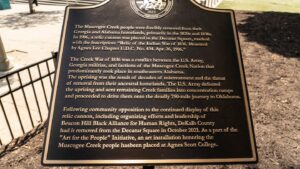
Another major blow to the development was the adoption of Georgia Senate Bill 625 on May 12. The bill requires voter approval on projects over $20 million, a figure the project was already estimated to exceed.
The board of education then pivoted to an alternative plan on Sep. 8- it would remodel and expand an existing early childhood learning center near the high school.
The Beacon Hill Historic District greenspace is safe for now, but the board of education, which still owns the property, has not announced any clear plans for the land.