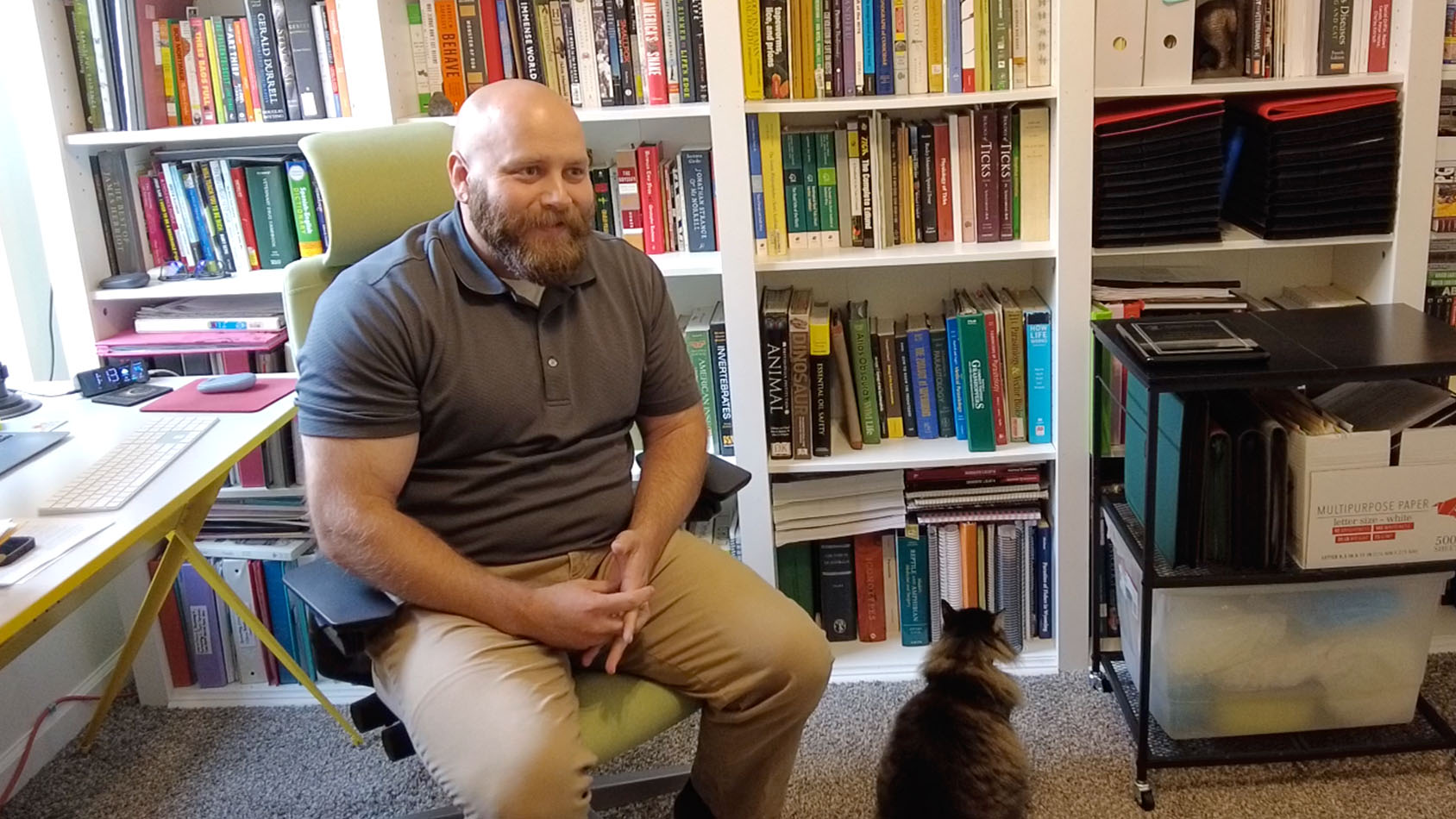
ARCADIA, Okla. – For Daniel Marshall, a career studying ticks was not exactly part of the original plan.
Marshall, a Muscogee (Creek) Nation citizen, earned his Ph.D. in entomology from Washington State University in 2025. His work focuses on the behavior and ecology of the Lone Star tick, a species common throughout much of the eastern United States.
His path into the field, however, began with mosquitoes.
Marshall earned a master’s degree in biology from the University of Central Oklahoma after becoming interested in medical entomology during the 2015-2016 Zika virus outbreak. When it came time to pursue a doctorate, he found a fully funded program at WSU and moved to the Pacific Northwest, despite having little experience working with ticks.
“I moved there not knowing anything about ticks, and I learned a lot,” Marshall said.
For his doctoral research, Marshall studied how Lone Star ticks move through their environment. He conducted mark-recapture studies, collecting ticks in the Stillwater area, marking them, and releasing them back into the woods to track their movements.
The work aimed to address a practical problem: traditional methods for surveying ticks do not always work well for Lone Star ticks.
Marshall continues to work with his former adviser on research to determine how researchers can more accurately detect and monitor tick populations. Their work includes developing mathematical models to determine how often researchers should sample an area, how long they should sample, and how many traps they need.
That research earned Marshall the 2026 John Henry Comstock Graduate Student Award from the Entomological Society of America’s Pacific Branch. The award is one of six presented annually by ESA, with one student selected from each branch of the organization.
Marshall said receiving the award was both surprising and validating.
His doctoral program required five years of work and meant moving away from his family. Having his work recognized by professionals in his field gave him a sense that his sacrifices had been worthwhile.
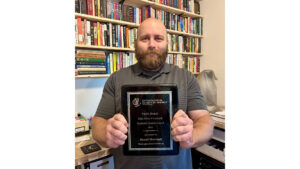
“It was validating,” Marshall said. “The Ph.D. was five years of my life. That was kind of full commitment.”
But his research was only part of what led to the recognition.
During his fieldwork at Lake McMurtry near Stillwater, Marshall developed an outreach program with a summer camp. He began speaking to children about insects, ticks, and staying safe outdoors.
What started as an obligation quickly became one of the most rewarding parts of his doctoral work.
More than 300 children eventually participated in the program. Marshall used photographs and hands-on activities to teach them how to identify ticks, where they were most likely to encounter them, and how to reduce their risk of tick-borne illness.
He also measured what the children learned before and after his presentations and found roughly a 30% improvement in their scores.
“That ended up being the most rewarding part of the whole thing,” Marshall said.
His work also carries a personal connection to Oklahoma.
As a citizen, Marshall said his heritage has influenced the questions he asks as a researcher. The Mvskoke Reservation is in an area where tick-borne illnesses are prevalent, something Marshall himself has experienced.
His identity has also shaped the way he experiences the scientific community.
At conferences, Marshall said Native students and researchers often seek one another out, creating a community within the broader field of entomology.
For Marshall, that representation matters.
“Everyone brings something different to the table,” he said. “Every single person has a different perspective and a different series of events that have led them to thinking a certain way that they do.”
He said having diverse perspectives in science helps researchers think more broadly and can preserve knowledge and perspectives that might otherwise be lost.
Marshall hopes his own career can provide that same encouragement to other native students considering careers in science.
His path has not always been easy, he said, and there have been plenty of starts and stops along the way.
“If somebody is wanting to go this route… I would like to encourage them to look back on what I’ve done so far and not be discouraged,” Marshall said. “You can always start over.”
Today, Marshall continues his research while also working through Marshall Biological Consulting, where he helps bridge academic, industry, and government research on arthropods affecting human and animal health.
His research on tick surveillance could eventually have applications beyond ticks. Marshall and collaborators are also working with the U.S. Department of Agriculture on methods to detect and monitor screwworm flies, an emerging concern for the U.S. livestock industry.
For Marshall, however, the work continues to return to the same basic idea: asking questions, learning from the answers, and continuing when those answers lead to more questions.
And for the next generation of Native scientists, he hopes his story shows that a difficult path does not necessarily mean the wrong path.
“I hope that people are at least willing to stick things out if they do choose to follow a similar route that I did,” Marshall said.