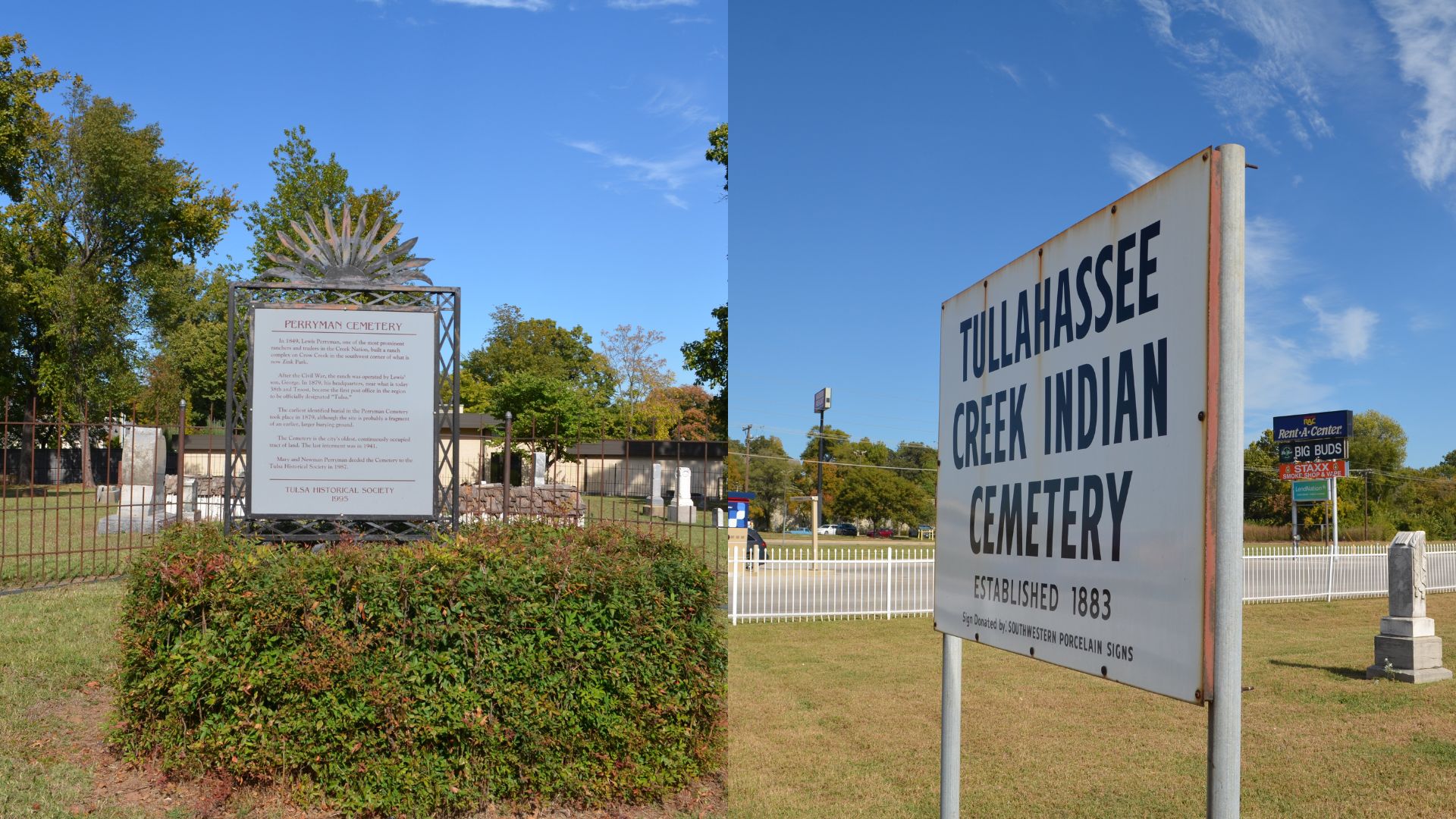
MVSKOKE RESERVATION – A strip mall parking lot in Sand Springs and an affluent Utica-area neighborhood share an unexpected feature: historic Mvskoke cemeteries.
One cemetery is nestled neatly in a corner lot next to a million-dollar home, while the other is a lonely green patch in a concrete sea in front of a dollar store.
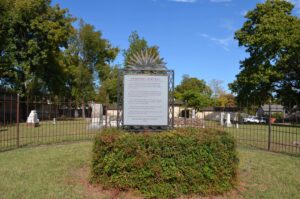
Perryman Family Cemetery, located near South Utica Ave and East 32nd Street in Tulsa, is the final resting place of some of Tulsa’s most prominent Mvskoke people.
In 1848, Mvskoke cattle rancher Lewis Perryman and his family moved to Tulsa from what is now the Broken Arrow/Wagoner area after a devastating cholera outbreak. Lewis eventually fled to Kansas during the Civil War and did not return to Oklahoma. He died in Kansas in 1862. Lewis was the son of Benjamin Perryman, who settled in Indian Territory after removal.
After the Civil War, Lewis’ son George Perryman took over the cattle operation and became known as the “Indian cattle king of the Creek Nation.” George would later marry Rachel Alexander. George and Rachel were known for taking in orphans, housing as many as 30 children at one point. They also had seven children of their own.
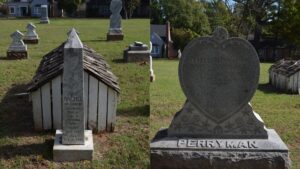
George’s brothers, Josiah and Legus, laid their own claims to fame. Josiah was Tulsa’s first postmaster, taking on the title in 1879. Legus became the Principal Chief of the Creek Nation in 1887 and served for two consecutive terms.
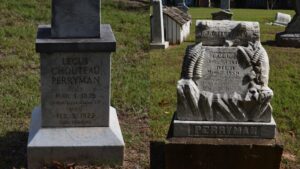
The Perrymans were a large family with several other prominent members, many of whom are buried in the family cemetery alongside George, Rachel, Josiah, and Legus. About 50 members of the family are interred in the Perryman Family Cemetery along with several unknown soldiers of the Civil War.
The first burial took place in 1879 with the internment of Lydia Perryman Beaver. Lydia was the daughter of Lewis and Ellen Perryman and sister to George, Josiah, and Legus. She was 29 years old when she passed away. Lydia’s husband, David Milton Beaver, and their son Amos Beaver are also buried in the cemetery.
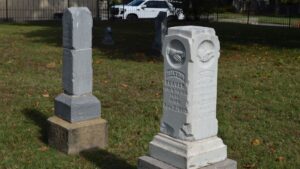
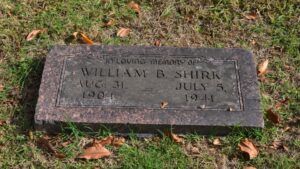
The final burial in the Perryman Family Cemetery was William Shirk’s in 1941. William was the grandson of George and Rachel Perryman, born to their daughter Mayme.
According to the Museum of Tulsa History, the cemetery fell into disrepair by the 1960s and was in imminent danger of being destroyed/relocated for land development. The cemetery was saved when the Perryman family deeded it to the Tulsa Historical Society in 1971. In 1987, Mary and Newman Perryman finalized the deed after clearing over a decade of legal red tape. This allowed the historical society to finally take over the care of the grounds.
Under the care of the Tulsa Historical Society, the cemetery has been fenced in, and several headstones have been repaired or replaced. Representatives with THS said that the residents of the surrounding homes lend a helping hand by letting them know when there are downed tree limbs or other maintenance needs.
THS also said that while the fence and Google business listing may discourage visitors, the cemetery is open to the public.
Visitors may notice a series of matching headstones dotted throughout the grounds. Those stones were installed by Benchmark Monument in 2014 as part of Tulsa Historical Society’s continued efforts to maintain the cemetery.
While there is always more work to be done to preserve the graves and grounds, the focus right now is returning the cemetery to the Muscogee (Creek) Nation, said representatives with THS.
MCN Secretary of Culture and Humanities RaeLynn Butler said THS reached out about returning the cemetery to the Nation. Butler said she sent that inquiry over to the MCN Realty Department, which has not provided any updates thus far.
Mvskoke Media reached out to the Realty Department for comment, but has yet to receive a response.
Meanwhile, in Sand Springs, the Tullahassee Creek Indian Cemetery has experienced significantly more deterioration than the Perryman Family Cemetery.
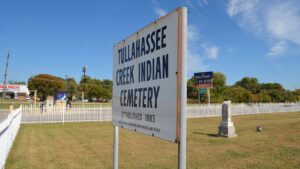
Established in 1883, the Tullahassee Creek Indian Cemetery is the final resting place for 34 people, according to a memorial marker, but records indicate several unknown and unmarked graves as well. Some early 20th-century witness accounts describe over 100 graves on the land at one time. The land is also described by these witnesses as being over an acre, a far cry from the few thousand square feet now marked off by the fence. Some local residents and historians believe additional graves may remain beneath the pavement.
The cemetery was established by Lieutenant Thomas Adams, a Mvskoke veteran of the Civil War. Thomas Adams died in 1886, only three years after designating the plot for the cemetery where he is buried.
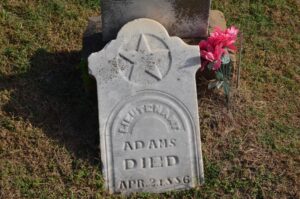
Andy Scott was the first person buried in the cemetery around January 2, 1883. Martha Fuswa was also buried in 1883, but her exact date of death is unknown. The final burial in the cemetery was Hattie Emarthla, laid to rest in 1912.
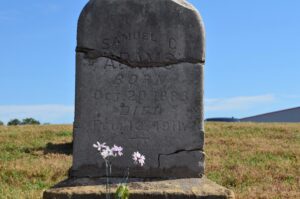
The land that the Adams family had occupied for many years was officially deeded to Samuel C. Adams during allotment. Samuel sold the land to Charles Page around the time of statehood. The details surrounding the allotment and subsequent sale of the land are hazy, with some accounts saying the land was sold in 1904 and others in 1908.
Samuel C. Adams died in 1911 at the age of 27. He is buried in the cemetery despite the land’s sale a few years earlier. According to a 1937 oral history, Mary Fuswa attempted to buy the cemetery from Page in 1918, but he refused. Several of Mary’s family members are buried in the cemetery, including her parents.
After Charles Page’s death in 1926, the land was deeded to the Sand Springs Home, Page’s nonprofit. Around the time of Page’s death, the Tulsa Chapter of the Daughters of the American Revolution maintained the cemetery and installed a sandstone marker.
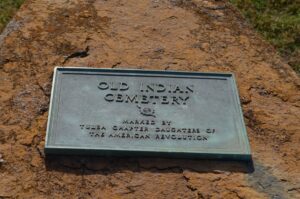
Page cared for the property until his death. Newspapers recount some renovations in the mid-20th century, but then the cemetery fell into disrepair over the next several decades. As the markers rust and the headstones continue to fall apart, the history of the Tullahassee Creek Indian Cemetery and those buried within is becoming more obscure with time.
The land is now maintained by the property management company that owns the shopping center. According to Robin Soweka Jr., Director of Historic and Cultural Preservation for the MCN, there has been no recent contact from the landowner, Bill Osmond, regarding the cemetery. Per NonDoc, Osmond reached out to the MCN through a friend who worked for the Nation, but nothing came of the informal inquiry.
“I can not speak for MCN,” said Soweka, “but I believe it would be good for the MCN to take over, rather than the city or state.”
Taking over care for the cemetery would allow the Cemetery Crew with the Historic and Cultural Preservation Department to maintain the grass and keep the cemetery clean. As for the suspicion that not all the graves were fenced off before the parking lot was built, the team could try to get answers using Ground-Penetrating Radar.
“The Historic and Cultural Preservation Department would be able to conduct a Ground Penetrating Radar (GPR) survey if the family or MCN would request [that],” said Soweka. He clarified that the GPR would be able to see “anomalies” under the surface, but it would not necessarily be able to identify what that anomaly is.
Unfortunately, the Cemetery Crew can’t fix or replace broken or displaced grave markers as the Cemetery Preservation program is not currently equipped to do so. Soweka said the crew is hoping to gain the capability to repair headstones in the near future.
The Tullahassee Creek Indian Cemetery is open to the public for visitation. There is not much visitors can do to help or protect the cemetery without landowner permission, but leaving the grounds a little better than they were found by picking up trash is always encouraged.
Anyone who has a Mvskoke cemetery on their property in need of help can contact the Cemetery Preservation program at (918) 732-7733.
Currently, the Cemetery Preservation program has logged over 370 cemeteries in its database. The program can help with mowing, fallen limbs or trees, and fencing.