This story is the first in a series by the Mvskoke News team focusing on Mvskoke climate solutions. This year, Mvskoke Media has been part of the Climate Beacon Newsroom Initiative, a collaboration between the Indigenous Journalists Association and the Solutions Journalism Network. Solutions journalism examines individual, group, and community responses to social problems.
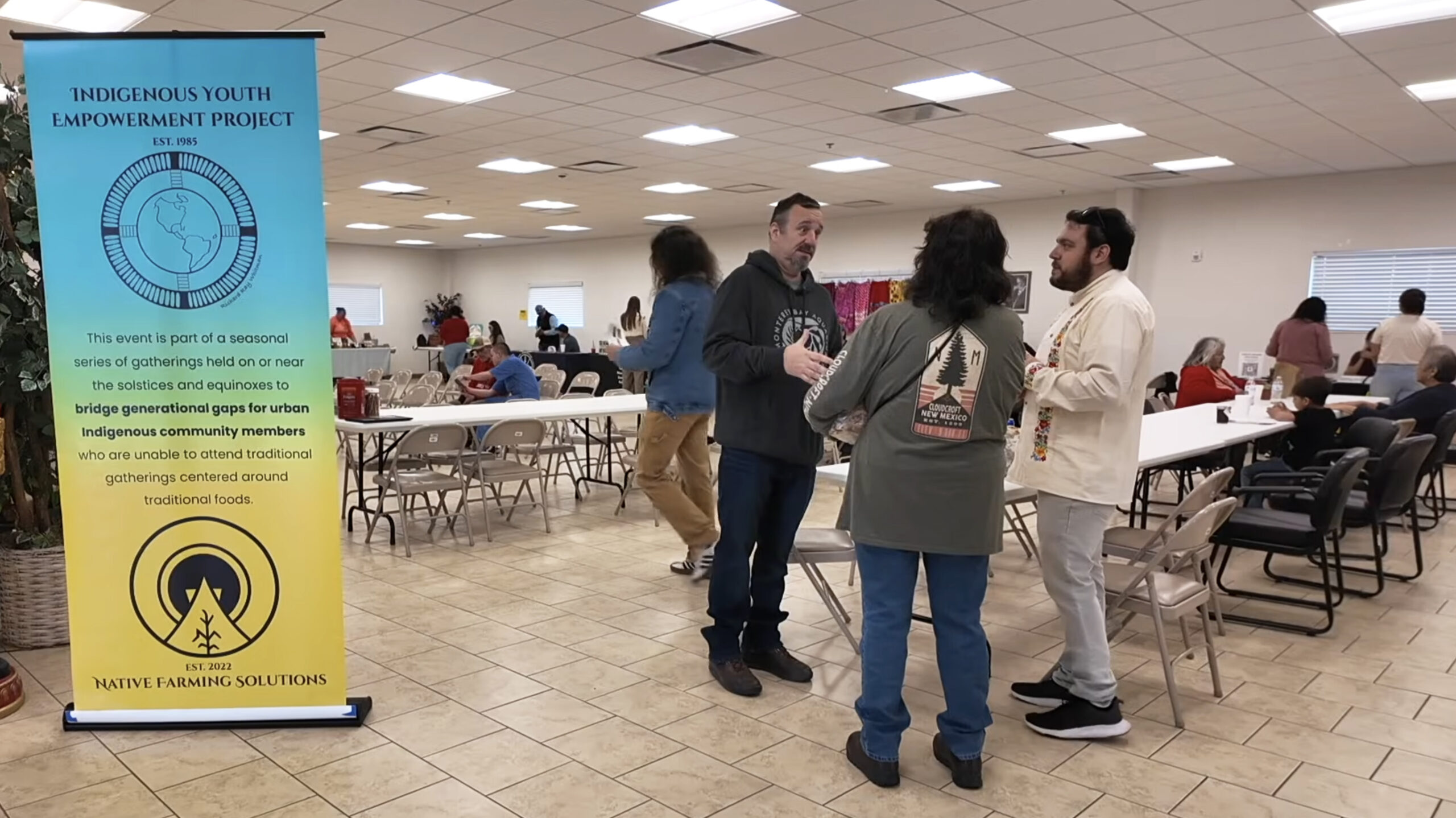
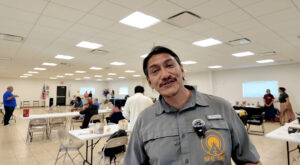
OKMULGEE – Citizens interested in local food production and increasing their community’s access to food had the opportunity to participate in an inaugural local market hosted by the College of the Muscogee Nation Extension Program. Partnering with Native Farming Solutions, the Taklike, Custake, Tavfvmpuce (Bread, Eggs, Wild Onions) Community Market at the Okmulgee Indian Community Center was created to support Tribal food sovereignty and sustainable agriculture in the Mvskoke Reservation, a founding goal of the CMN Extension Program.
“One of CMN Extension’s main goals is to play a part in establishing food sovereignty across the Mvskoke reservation. Right now, the majority of the food we provide to citizens is outsourced and shipped in on trucks from far away. We aim to empower Native agriculture producers, connect citizens with locally produced foods, and encourage Mvskoke citizens to produce their own food at home. Whether that be via animals, gardening, preserving, or cooking. Everyone has skills and a part they can play,” stated CMN Extension Coordinator, Courtney Natseway (Mvskoke/Yakama/Laguna Pueblo).
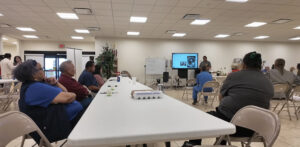
The March 6 market hosted vendors, cooking demonstrations, and educational workshops about community farming and food sources. Lectures and workshops focused on seasonal and traditional food, Tribal health and wellness, and local food systems.
Natseway said the turnout was great, especially during lunch hour, and saw many elders attend. During that time, organizers held a bean cook-off between CMN, Native Farming Solutions, and the OKC Food Hub, with CMN taking first place. OKC Food Hub also donated all the food for the event.
Owner of Native Farming Solutions, Travis Andrews (Navajo/Canadian Cree), has organized community markets in Oklahoma City and, through previous work with the CMN Extension Program, helped to bring that format to the Mvskoke Reservation. Andrews focuses on seasonal foods; for the market, they focused on bread, eggs, and wild onions.
Throughout the day, Andrews spoke about gardening and how to get started, how to start seeds, how to fertilize, and how to prepare land. Other speakers touched on a variety of topics, including soil building and fungi, pepper harvesting, and plant medicine.
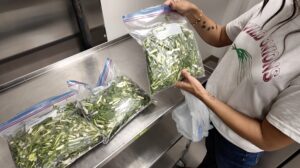
A cooking demonstration was taught by Nico Williams (Cherokee), the Founder and Executive Director of Burning Cedar Sovereign Wellness. Williams made tafvmpuce (wild onions) with custake (eggs) and wild onion fritters.
Community markets can connect
Natseway spoke about food sources and the disconnect people have with where their food comes from.
“I think community markets like these are effective in connecting consumers to local food sources. The community markets differ from farmers’ markets because there is also an educational and cultural component,” said Natesway.
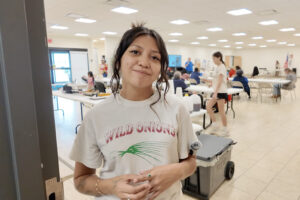
“Not only do they connect people to local food, but they also inform people on how to prepare or preserve these local foods, and then we share a meal created with these local foods.”
Natseway made the point that people tend to buy a gallon of wild onions from their aunt’s friend, yet don’t know where the wild onions were harvested. Natseway loves connecting people to the source.
“I think traditionally we kind of just ate what was in season. I feel like that’s the most nutritious, like that’s where your body’s absorbing the most nutrients. We had local egg producers there, like ladies who have chickens that have eggs and who make jams and jellies. We had sprouts there,” Natseway said.
Local farm to local consumer
Communities across the Mvskoke Reservation can benefit from supporting sustainable local food production from farm to consumer.
“When food is produced locally, it is easier to get information about production practices and determine their impacts on climate change. ‘Farms’ can include larger-scale commercial producers as well as garden-to-market, smaller-scale growers. All can contribute to the local food system and its resilience to climate change,” from the University of Wisconsin-Madison site about Climate-and-Farm-Friendly Food Systems.
When climate changes occur, they can affect these different links within the food system. According to the National Center for Atmospheric Research, “Adaptation to climate change is changing the way you do things in order to lessen the impacts of climate change. For example, farmers can change the way they manage their crops.”

When speaking about participating in the market and spreading knowledge to the Mvskoke community, Natseway had a fun time. “It was fun to connect people to where their food comes from, so it’s fun to kind of bridge that gap,” said Natseway.
She also enjoyed eating lunch with everybody, socializing, and looking at the different vendors that came.
“I feel like these are things that we did, we ate wild onions for Easter every year growing up, but it’s fun to connect people that have never tasted or done that. It’s fun to create that safe space for them to try all of this new cultural stuff or to ask questions about all of this culture without them feeling scared,” Natsway said.
“So it’s fun being able to facilitate spaces like that. It’s really rewarding.”
Meeting the needs of the community
The CMN Extension Program is looking at the Native Farming Solutions example and planning seasonal community markets for the Reservation.
Native Farming Solutions was created to cultivate traditional foods and medicines for the local ceremonial community, serve as a resource for cultural preservation and enrichment, and support the wellness of Native youth and communities.
“The markets serve as community markets vs farmers’ markets. Today, farmers’ markets are really vendor markets. There’s not much money to be made in growing food for your community. Many urban communities lack garden space to cultivate for commercial purposes, and most people would rather have different hobbies besides gardening for wellness,” Andrews said.
“The community market concept differs from farmers’ markets because it’s designed to meet the immediate needs of the local community. Community markets strategize their product sourcing and pricing to be realistic and reasonable while creating a local economy for producers, processors, and distributors,” Andrews said.
Native Farming Solutions grows foods like collards, dino kale, mustards, eggplants, cucumbers, and beets.
“What we’re hosting are pilot markets that emphasize local foods, arts, and music. Our version is designed by local natives for local natives. The market serves as the access point for products and education centered around local native talent,” Andrews said.
When speaking about what works in community markets, Andrews stated that networking works best for them when it is between organizations, as it helps connect with larger audiences.
“What is challenging is keeping up with is marketing and branding as a non-profit grassroots organization,” Andrews said.
“As far as being effective, the markets are still new but are receiving great feedback. We’ve been told, ‘this is a vibe we didn’t know we needed…’. It serves as a great networking event between our local food supply chain community and also in bridging gaps between the local food supply chain, the general public, and the urban native community,” Andrews said.
Andrews is also the Garden Program Manager at Skyline Resource Center, located in Oklahoma City. The center has one of the oldest food banks in the Oklahoma City metro area, having been in operation for 50 years.
Skyline is also a hybrid operation, with its community garden producing fresh produce that goes into its own food pantry. “This organization seeks to overcome barriers to get resources to the community,” Andrews said. “Food banks are food security, but community gardens are food sovereignty. We practice both, and we’re the only places that do.”
Andrews is big into landscaping and has presented on edible landscaping, which is when he realized he was speaking about permaculture and food forests. “To me, that’s us coexisting with our environment and reshaping it to be beneficial for us, the bugs, and everyone else. That’s what I want to get back into is Indigenous methods,” Andrews said.
“This kind of ties into a concept that I like teaching about Indigenous farming, traditional ecological knowledge, and how, at one time, we were known for reshaping massive landscapes. That is what we were good at,” Andrews said. “I always say, like simply walking around pockets full of wildflower seeds and throwing them in the right areas, we can still do it.”
Andrews emphasizes that, in the long run, the bugs and worms are just as important as the people.
“I want there to be a whole bunch of fruit in the trees, native wild flowers like all over. If we can accomplish that, then we’re practicing our ancestral ways. Rescaping our local landscape.”
Planning Mvskoke community markets
CMN’s Extension not only wants to continue community markets but also, within their own college facility, develop a five-year plan that includes an eco-park and student farm, a food co-op, Mvskoke-made product marketing, and a food preservation building. The plans also include growing at scale to support the senior nutrients programs and the college’s Core Values Cafe. A goal of the program has always been to emphasize Traditional Ecological Knowledge, Tribal Food Sovereignty and Security, and sustainable agriculture.
With more preparation, the Extension Program is hoping future markets will be bigger and better.
“I’m hoping to see friendships and relationships established between Mvskoke Ag producers and consumers,” Natseway explained. “We planned this event in less than three weeks! We pulled it off, but I would like to start planning sooner next time. I would like to include more hands-on/interactive activities, including activities for children.”
Stay up to date on the next community market and other CMN Extension Program events at their website, extension.cmn.edu.