“With aquaponics, we control the environment. We control the situation in there. Anything that goes wrong in there is because of our own mistake. We have created a natural environment in there, an ecological balance, just like Mother Nature inside.” – Bob Rider
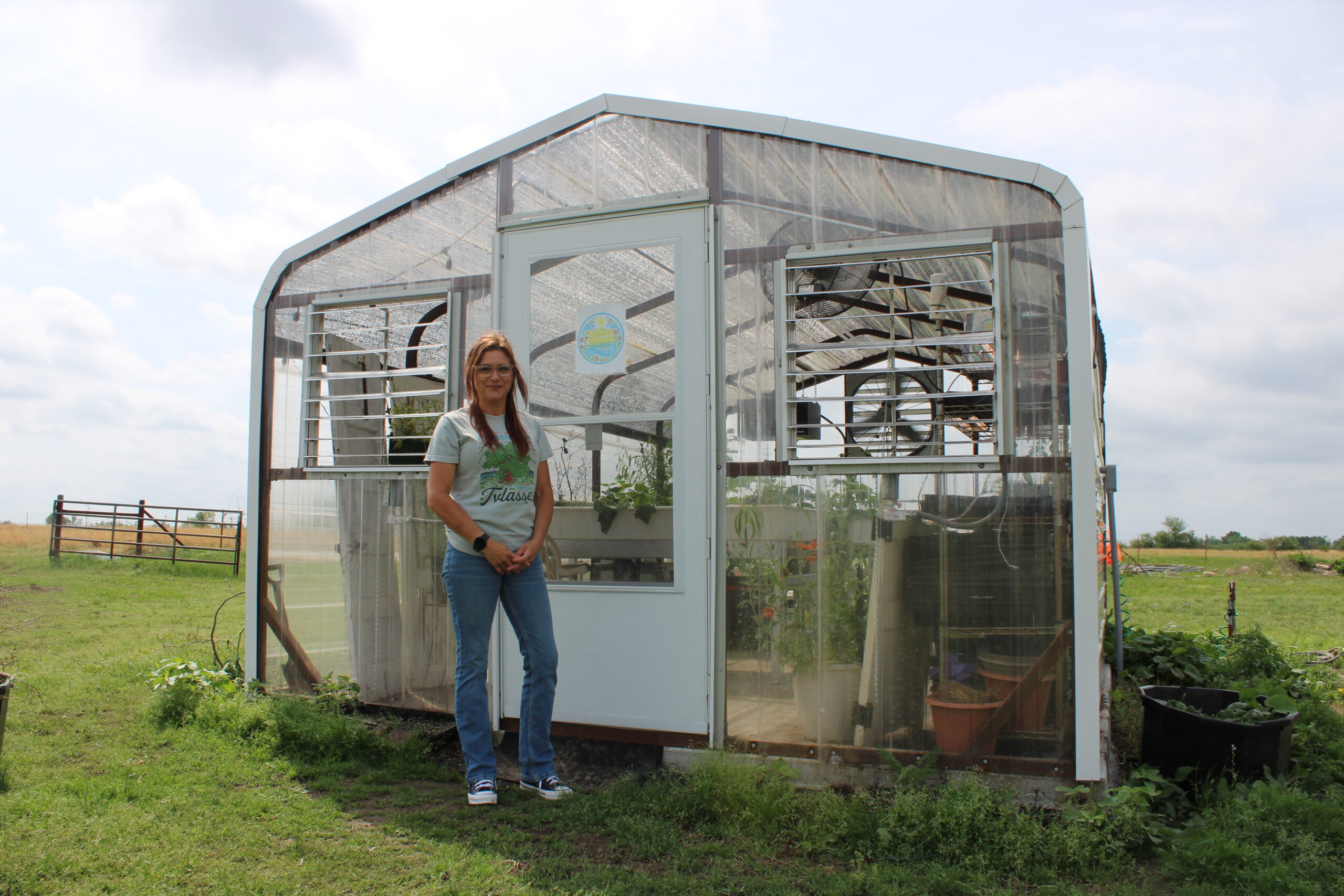
MORRIS – On Melissa Welch’s (Mvskoke/Cherokee) property lies an inconspicuous greenhouse south of her house. Step inside, and you’ve entered Welch’s non-profit, Native Bloom Aquaponics. Welch comes from a farming family. Growing up, her grandparents tended 30 acres of farmland on their allotment in the Ryal area. Welch’s greenhouse can produce vegetables, as well as native plants and flowers. Her mother raised her own flowerbeds and pollinator gardens. “My green thumb was inherited from them,” Welch said.
Aquaponics is a soilless method of growing crops that combines aquaculture and hydroponics. Through this method, farmers can grow crops in confined areas year-round regardless of the region’s climate or season.
Aquaponics can present endless solutions to climate change, food sovereignty, and sustainability. It can yield crops up to four times faster while using less water than traditional farming. In addition to plants and produce, the system can also grow livestock feed and fertilizer. Safely stored in a climate-controlled enclosure, crops are protected from predators such as birds and insects, as well as drought. Once a greenhouse has accumulated the microbes and bacteria it needs, Welch said it can be just a matter of days before a newly-planted seed starts to germinate. The method also eliminates the need for weeding and digging.
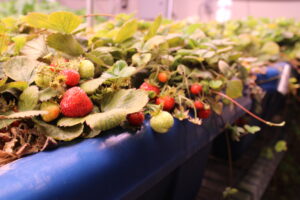
Welch was familiar with aquaponics through her previous work at the Euchee Butterfly Farm, a Mvskoke-owned nonprofit that houses endangered pollinators. She now works as a nutrition manager at the Muscogee (Creek) Nation Food Distribution and manages the Muscogee Hands of Harvest garden in Okmulgee. The garden provides supplemental fresh produce to distribution clients and to the Elderly Nutrition Program. This spring, Welch harvested Romaine & Bunch lettuce, turnips, radishes, broccoli, cabbage, beets, and scallion onions. Welch was recently accepted into the Oklahoma Conservation Commission Soil Health Implementation Program (SHIP), a three-year program in which participants develop a plan to elevate soil health management strategies.
In 2021, the MCN Conservation District received a grant from the Native American Agriculture Fund. The grant provided the Nation with $197,060.73 to help citizens procure and operate their own aquaponic greenhouses. The MCN Conservation District built its aquaponics system at the Morris Indian Community Center.
Welch was one of four Mvskoke citizens who were selected to receive their own aquaponic greenhouse. Her previous experience at the butterfly farm was operating hydroponics towers. A hydroponic tower is a similar system to aquaponics without fish. The towers grow herbs, vegetables, and pollinator plants. In Welch’s experiences, the system is affordable and adaptable- the tower system can be as small or large as needed.
Now, Welch operates her own nonprofit where she grows traditional Mvskoke crops in her greenhouse, including tobacco, pumpkins, corn, pinto beans, honeysuckle, and minara.
“I think this is the way of the future, especially with land development growing rapidly,” Welch said. “If we can have an aquaponic greenhouse to control those environments, the environmental issues with pests, sprays, and overdevelopment, and have adequate space. We could produce hundreds of pounds of produce a year,” Welch said.
An inside look
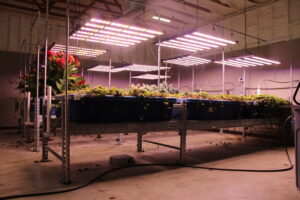
An aquaponics system uses a tank to grow fish like tilapia, channel catfish, and bass. In the tanks, bacteria break down fish waste into fertilizer. Plants and crops are grown in raised beds filled with sediment rather than soil. The fertilizer-rich water from the fish is used to irrigate the plants in an indoor chamber. Aquaponic systems can be set up in small or large indoor areas as long as there is a 1:1 ratio of fish tanks to crop beds. The system can grow common crops like spinach, herbs, tomatoes, cucumbers, beans, and peppers.
Aquaponics not only yields a harvest, but it also generates pride in the process. In addition to watching produce grow into a full crop, farmers also see fish grow. Once fully mature, both the crops and the fish can be harvested for food. Fresh watermelon or squash can be enjoyed out of season in January.
Self-sustainable farming can combat higher grocery and energy costs in 2026. The United States Joint Economic Committee reports that food price inflation increased 2.68 percent from March 2025 to March 2026. In that same time frame, energy price inflation increased 12.53 percent. Welch said a backyard aquaponic greenhouse can provide a farm-to-table solution right in your own backyard, and you know exactly where your food comes from.
Dreams and realities
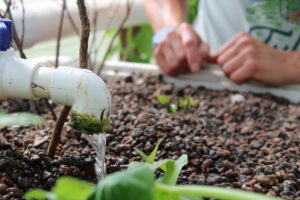
Welch’s aquaponics greenhouse was built by Bob Rider, the founder and owner of Olive Branch Aquaponics. He has been involved with aquaponic farming for over 20 years. Rider’s journey with aquaponics began with a vision as a young child. He still remembers the vision in great detail; he did not understand what it meant until he was an adult.
“I had a dream when I was eight years old. I was inside of a bubble, inside this bubble looked like the Garden of Eden. When I stood in the vegetation inside I looked outside the bubble, there were blue skies, with a little white cloud in the sky, it was beautiful, but I knew it was contaminated. I knew it was poisonous with pollution. Things were getting to where we couldn’t maintain outside,” Rider said.
“The Garden of Eden inside was our food production. That stuck with me over the years.”
As Rider tells it, many years later, one day, he was sitting inside his greenhouse. Tired, he leaned back into his chair and looked outside. What he saw was a blue sky with one white cloud. Looking back inside, he remarked that the greenhouse looked like the Garden of Eden, just like in his vision. It was then that he said he knew the vision was a strong calling to aquaponic farming.
Ever since that day, sitting inside the greenhouse, Rider has made it his mission to build aquaponic greenhouses and educate others on how to take charge of their own food production. Through Olive Branch Aquaponics, Rider has built aquaponic greenhouses for clients in the community and around the world. Rider said that the greenhouses work in virtually any climate.
“We can reach the world through aquaponics. I’ve been to Africa because they have bigger problems over there than we do here. I put these in for farms, orphanages, daycares, and refugee camps,” Rider said.
“Aquaponics gives us the opportunity to control what we can’t control outside.”
According to Rider, aquaponic farming can be intimidating upon first glance. He admitted he was initially skeptical of the system’s capabilities. Cost is one limitation.
Starting up can be expensive due to the costs of erecting a greenhouse, installing a water filtration system, and acquiring the proper beds and sediments. Although crops are protected from insecticides and drought inside the greenhouse, the structure is still prone to storm damage. Welch’s greenhouse cost $40,000, which she funded through the MCN CD grant. It required installing an electric mainline from her house, which increased her monthly utility bill.
Time is another investment. It can also take up to a year for the environment to be ripe with the microbes and bacteria required to germinate seeds. Likewise, not everyone who works a full-time job may have the time and energy it takes to dedicate to an aquaponic greenhouse.
Despite the limitations, Rider says that the investment is worth it. According to Rider, a 200-square-foot aquaponic greenhouse can produce as much as an acre of traditional farming.
College of the Muscogee Nation Extension Educator Courtney Natseway sees aquaponics and hydroponics as solutions for farming in extreme climates. The college has a hydroponic tower that fits inside a campus closet. Agreeing with Welch, Natseway said the system is a strong solution for extending farming seasons.
The college encourages adults to learn about aquaponics and hydroponics through some of their evening classes. Aquaponic and hydroponic systems can be viable gardening options for those living in homes without yards.
“It’s a good solution for people who don’t have a lot of outdoor space or if they have poor soil quality, or if they only have a balcony, they can,” Natseway said. “Just starting your own something, for some people, aquaponic or hydroponic is what’s best for them with their limited space and resources.”
Natseway echoed Rider’s view that those unfamiliar with the farming method may struggle at first. Transporting and selling the fish used in the aquaponic tanks requires a license in Oklahoma. According to Natseway, the method is more practical for the average person to grow their own food crops, rather than for commercial use.
Rider has dedicated his life to educating on aquaponics because he sees it as a sustainable way to feed the world. Rather than simply providing food, he wants to empower others to grow their own; for him, teaching people to feed themselves creates a far more lasting impact.
Natseway would like to increase the number of hydroponic towers in the extension program going forward. Welch, who has grown produce in her greenhouse for several years, now teaches classes on aquaponics through the CMN Extension Office’s master gardener program. She said that aquaponics is a farming method that is both youth and elder-friendly.
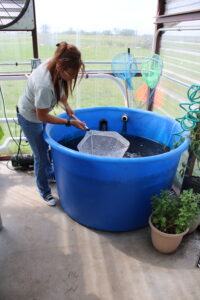
“I teach others, especially elders, that this is convenient. It is in a controlled environment. They don’t have to lean over onto the ground. Raised beds that are waist-high, those are feasible for a lot of our elders. They can be in a condition that’s comfortable and have a stool or standing area. It’s all confined to one area,” Welch said.
For those interested in learning about aquaponics, Oklahoma State University Extension has published a printable factsheet with step-by-step instructions for getting started. It contains information about aquaponics equipment, garden beds, plumbing, and the types of plants that can be grown in an aquaponics greenhouse.
Native Bloom is open to community members. Its goal is to teach others how to become self-sustaining by growing their own food. Welch remarked that aquaponics and gardening are constructive activities for children and elders. Native Bloom is currently establishing a web and social media presence. For now, Welch says the best way to learn more about Native Bloom is to text her at 918-759-8513.
This story is part of a series by the Mvskoke News team focusing on climate solutions on the Mvskoke Reservation. This year, Mvskoke Media has been part of the Climate Beacon Newsroom Initiative, a collaboration between the Indigenous Journalists Association and the Solutions Journalism Network. Solutions journalism rigorously examines evidence-based individual, group, and community responses to social problems. The initiative supported our newsroom’s skills development in story production, specifically stories focused on responses to climate and environmental challenges.