
The following is a press release from the Indian Gaming Association
TULSA, OK. — AUGUST 28, 2026 — Indian Gaming Association Chairman David Z. Bean continued IGA’s national outreach on the growing threat of illegal prediction-market gambling Thursday, delivering a forceful message to Tribal leaders gathered yesterday at the United Indian Nations of Oklahoma Quarterly Meeting: Indian Country must remain united, engaged and relentless in protecting Tribal sovereignty and the legal foundation of Indian gaming.
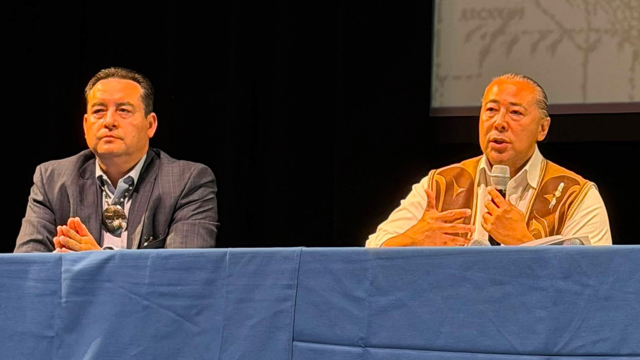
Speaking alongside Oklahoma Indian Gaming Association Chairman Matthew Morgan at the University of Tulsa’s Lorton Performing Arts Center, Bean updated Tribal leaders on the coordinated national effort among Tribal Nations, Native organizations, Tribal gaming associations, state officials, legal experts, industry partners and congressional leaders.
“It takes a team effort to address any threat to Indian Country. It takes a team effort to address any existential threat against Tribal sovereignty,” Bean said. “And that’s exactly what these prediction markets present: an existential threat to Tribal sovereignty, to Indian gaming.”
Bean said prediction markets rapidly expanded from wagering on elections, weather and pop culture into sports betting, creating a pathway into the online gambling market while attempting to operate under federal commodities law rather than the established federal, Tribal and state gaming regulatory framework.
For IGA, the issue goes beyond lost gaming revenue.
It is about jurisdiction, the Indian Gaming Regulatory Act and whether outside companies can enter Tribal and state jurisdictions and offer gambling without the consent of the governments that possess the legal authority to regulate it.
“We shouldn’t have to first demonstrate the negative impacts of any illegal activity. Let’s start and acknowledge there is illegal activity to begin with,” Bean told Tribal leaders. “All we’re asking Congress to do is demand the CFTC enforce their laws.”
Bean commended the extensive outreach and collaboration taking place across Indian Country, emphasizing that the progress made on prediction markets has resulted from Tribal Nations and Native organizations working together with a unified purpose.
“We don’t do it alone,” Bean said. “We work alongside all the Tribal organizations and Tribal leaders. We work with state attorneys general and the American Gaming Association. We also work with consumer protection groups.”
Tribal leaders have traveled to Washington, D.C. in significant numbers over several weeks this summer to educate members of Congress about prediction markets, the CLARITY Act and the consequences for Tribal sovereignty and regulated gaming.
“When Tribal leaders show up in D.C., it is noticed. It has great impact,” Bean said.
Bean said that direct Tribal participation has helped move congressional discussions beyond basic questions about prediction markets and toward a broader understanding of their impact on Tribal Nations, states and the national gaming regulatory system.
“We are working nationally to protect your right to engage in sports betting,” Bean said. “For any Tribe with interests, we’re working to protect their right to do so by educating Congress, engaging with the relevant federal agencies, engaging with our relatives from the American Gaming Association, engaging with industry experts and, most importantly, getting input from Tribal leadership across the nation.”
Bean also commended the Indian Gaming Association staff for the sustained work required to coordinate outreach, monitor rapidly changing legislative and regulatory developments, communicate with member Tribes and Tribal organizations and support IGA’s legal, legislative and communications strategies.
“Tribal input and participation have a strong impact across Congress and the Courts,” Bean said. “I can’t overstate the importance of that.”
United Indian Nations of Oklahoma Executive Director Margo Gray said UINO will continue to elevate the issue for its member Tribal Nations and to work alongside national and regional partners.
“United Indian Nations of Oklahoma continues to elevate the issue of illegal gaming markets that infringe on the sovereignty of our Tribal nations,” Gray said. “I want to thank David Bean, Chairman of the Indian Gaming Association, and Matt Morgan, Chairman of the Oklahoma Indian Gaming Association, for meeting with our members and sharing how they, alongside UINO, are advocating to rein in these illegal gaming markets. Together, we continue to push for action by state and federal lawmakers to exercise the appropriate oversight.”
Particular concern during the UINO discussion centered on the Commodity Futures Trading Commission’s lack of meaningful engagement with Indian Country.
The CFTC has invited representatives from 16 Tribal organizations to participate in a September 14 roundtable on prediction markets. The meeting follows yearlong requests from IGA for Tribal consultation, along with repeated calls from senators and Tribal advocates for the agency to engage Indian Country.
Bean said IGA’s experience with the agency has raised serious concerns about whether the latest outreach represents meaningful consultation or simply an effort to satisfy political pressure.
The late Chairman Ernie Stevens, Jr. had requested engagement and Tribal consultation with the CFTC as the prediction-market issue emerged in early 2025. After Bean assumed the chairmanship, IGA intensified those efforts and secured a meeting with CFTC leadership.
“My predecessor, Chairman Stevens, requested a meeting with the CFTC, requested a consultation, Tribal consultation,” Bean said. “He wrote them a letter. He verbally requested it. The CFTC agreed to it in April 2025, then abruptly cancelled it without explanation. When I took over early in 2026, we requested a meeting with the acting-chair of the CFTC, then the nominated candidates to the CFTC, and finally to the Senate-confirmed CFTC Commissioner.”
Bean described the eventual meeting as dismissive and lacking meaningful engagement.
“That was a check-the-box type meeting,” Bean said.
IGA specifically raised the federal government’s Tribal consultation responsibilities and the importance of government-to-government consultation when federal actions have significant consequences for Tribal Nations.
Bean said meaningful follow-up did not occur until members of the U.S. Senate pressed the agency to engage with Tribes.
For IGA, inviting Tribal organizations to a roundtable cannot substitute for formal consultation with sovereign Tribal governments.
Consultation is not a courtesy and it is not a procedural box to check after significant policy decisions are already moving forward.
Bean reminded Tribal leaders that IGA’s work on prediction markets began under the leadership of the late Chairman Ernie Stevens, Jr., who recognized early that the issue represented a threat not only to gaming revenues, but to Tribal sovereignty, jurisdiction and the federal government’s responsibilities to Tribal Nations.
Bean has continued and expanded that work while strengthening partnerships across Indian Country and beyond.
He also credited Stevens with building the relationship between Indian gaming and the American Gaming Association that today allows Tribal and commercial gaming interests to work together where their interests align.
“My predecessor, Chairman Ernie Stevens Jr., he bridged a relationship,” Bean said. “He was persistent in going back time and time again. He finally forged and developed a relationship with the American Gaming Association. So we can work side by side.”
That legacy of coalition-building remains central to IGA’s current strategy.
During the UINO discussion, OIGA Chairman Morgan also commended Bean’s leadership since assuming the IGA chairmanship, recognizing his extensive travel and direct outreach to Tribal leaders across Indian Country.
Bean made clear that the national effort will continue and intensify this fall.
Bean repeatedly returned to one central point: Indian Country should not have to demonstrate devastating economic harm before illegal gambling activity is addressed.
The federal government should not allow gaming to occur first and then ask Tribal Nations to calculate the damage later.
IGA has nevertheless commissioned an economic impact study to address reports of declining regulated sportsbook activity and under-21 participation connected to prediction-market expansion. IGA is also educating lawmakers about employment, government revenue, responsible gaming protections and the governmental nature of Indian gaming.
“Our revenues from our Tribal casinos are 100 percent taxed by the Tribes to provide essential government services,” Bean said.
But the economic argument remains secondary to sovereignty.
The first question is whether federal law and Tribal jurisdiction will be respected.
Bean warned that if companies are permitted to bypass Tribal and state gaming laws by labeling gambling as a financial product, the consequences could extend far beyond sports betting.
“If you look at the CLARITY Act in depth, you see it opens up the door for casino-style gambling on decentralized finance platforms,” Bean said.
IGA continues advancing legislative, regulatory and legal strategies, including preparation for litigation that could ultimately reach the United States Supreme Court.
The IGA-NCAI Taskforce, working in conjunction with the Washington Indian Gaming Association and other partners, is preparing a Supreme Court amicus brief intended to give Tribal Nations across Indian Country an opportunity to stand together.
“I encourage you to be on the lookout for that brief,” Bean told the UINO gathering.
The message from Tulsa was clear: Indian Country’s growing unity is having an impact, but this is not the time to slow down.
Tribal Nations and Tribal organizations must continue pressing Congress, demanding meaningful consultation, participating in litigation and standing together against efforts to bypass IGRA, Tribal-state compacts and the inherent sovereign authority of Tribal governments.
“Every step of the way, we’ve been challenged on this issue, from a captured federal agency to prediction markets advertising on Indian land,” Bean said.
IGA will continue traveling throughout Indian Country, working alongside Tribal leaders and Native organizations, supporting its member Tribes, engaging Congress, challenging federal agencies and preparing the legal strategies necessary to protect Tribal gaming.
The groundwork established by Chairman Stevens continues under Chairman Bean with a clear message for the months ahead:
Indian Country cannot allow federal agencies or private companies to define Tribal sovereignty for Tribal Nations.
Consultation cannot simply be a box to be checked.
And the push by Indian Country must not stop.





this is the same commission that honored
Eddie Tullis, former Tribal Chair of the Poarch Indians, who was in charge when they descrated out ancestors.
why are we reporting on what they have to say